Introduction: Carbon-Document Fatigue Is Real
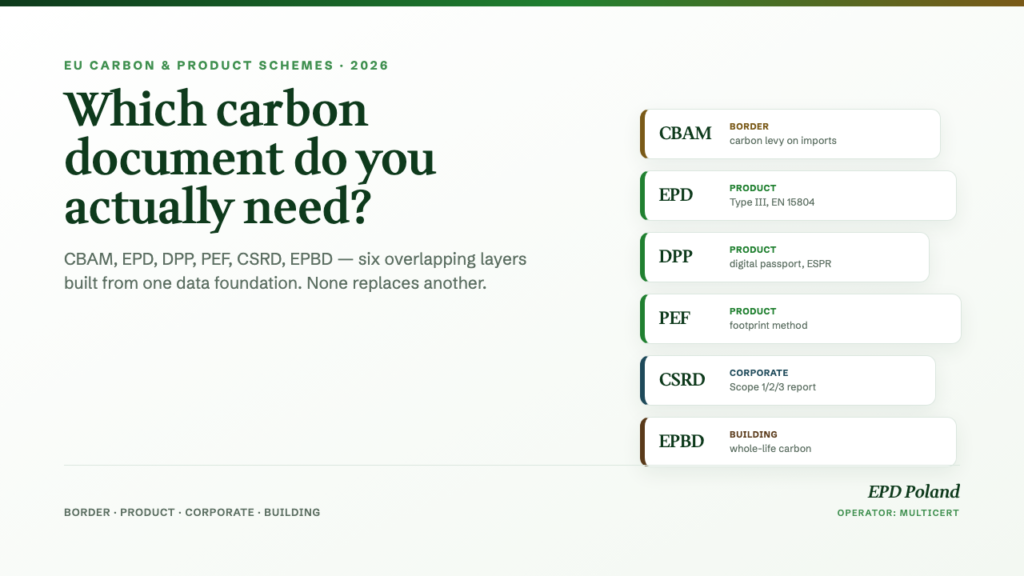
By 2027 a single steel product can sit inside CBAM, an EPD, a Digital Product Passport, PEF claims, CSRD reporting and EPBD whole-life carbon — six overlapping EU schemes that are constantly confused for one another.
Manufacturers keep asking the same question: do I need a CBAM number, an EPD, a Digital Product Passport, a PEF, or something for CSRD? The honest answer is that these are different layers — product, corporate, building and border — built from overlapping data, and none of them replaces another. This article disambiguates them in one place and tells you which you actually need.
The Six Carbon Documents at a Glance
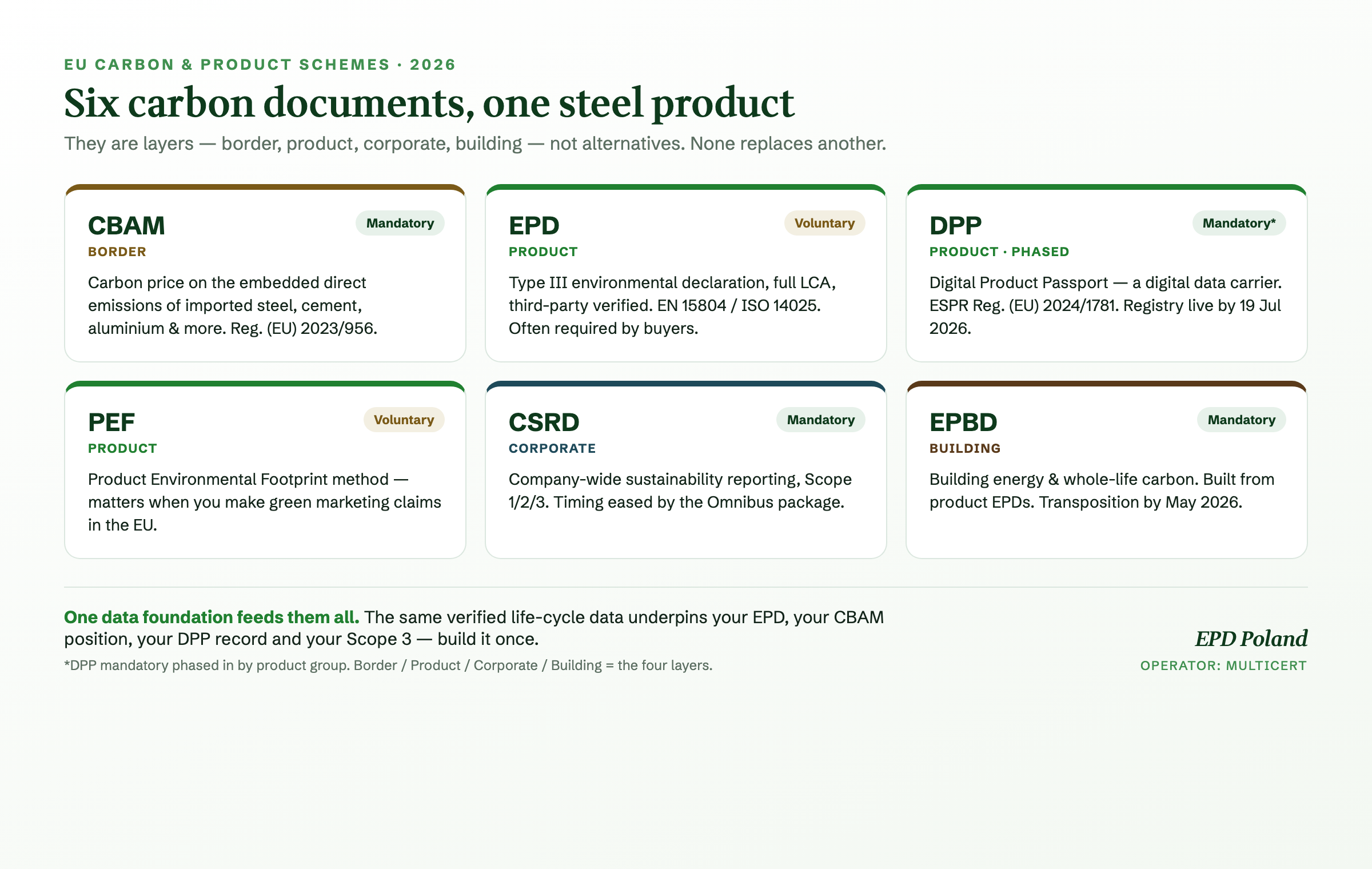
| Scheme | What it is | Mandatory? | Who | Layer |
|---|---|---|---|---|
| CBAM | Border carbon levy on imported goods (Reg. (EU) 2023/956) | Yes (importers) | EU importers of covered goods | Border |
| EPD | Type III environmental declaration (EN 15804 / ISO 14025) | Voluntary (often required by buyers) | Product manufacturers | Product |
| DPP | Digital Product Passport (ESPR Reg. (EU) 2024/1781) | Yes (phased by product group) | Producers in scoped groups | Product |
| PEF | Product Environmental Footprint method | Voluntary (for green claims) | Anyone making claims | Product |
| CSRD | Corporate sustainability reporting (Scope 1/2/3) | Yes (large companies; timing eased by Omnibus) | Companies | Corporate |
| EPBD | Building energy & whole-life carbon | Yes (buildings) | Building owners / designers | Building |
How They Differ — and Why They Don’t Replace Each Other
CBAM is a border instrument: it puts a carbon price on the embedded direct emissions of imported steel, cement, aluminium and a few other goods, so importers pay what EU producers pay under the ETS. It measures one thing — greenhouse gases — for one purpose: settling certificates.
An EPD is a product declaration: a full life-cycle assessment across many indicators, third-party verified, used in green building and procurement. Its carbon figure is not a CBAM value, but its underlying data feeds a CBAM calculation. (We cover this in detail in EPD and CBAM.)
The Digital Product Passport (DPP) is a data carrier: under the ESPR, products in scoped groups must carry a digital record of their characteristics, including environmental data. The central DPP registry must be operational by 19 July 2026; steel and aluminium are among the first product groups in the 2025–2030 work plan, while construction products carry their own DPP route through CPR 2024/3110 and the EU Construction Products Database. A DPP can carry EPD data; it does not produce it.
PEF is a method for footprinting, relevant mainly when you make environmental marketing claims in the EU. CSRD is corporate: it reports your whole company’s Scope 1/2/3 emissions, not a single product. EPBD is about buildings: operational energy plus whole-life carbon, where EPDs feed the building-level calculation.
The pattern: four layers (product, corporate, building, border), one underlying discipline — primary life-cycle data. Build that foundation once and most of these schemes draw from it.
One Product, Six Documents: A Worked Example
Take a single steel structural component sold into EU construction and watch one set of numbers travel:
- You commission a life-cycle assessment and publish an EPD (EN 15804). It reports the product’s global warming potential across modules A1–A3 and beyond.
- The A1 raw-material data — the embedded emissions of the steel itself — is exactly what your CBAM position needs if you import that steel.
- The same declaration becomes a record in your Digital Product Passport once steel enters the ESPR scope.
- Your customer, a large contractor, pulls the EPD figure into their CSRD Scope 3 reporting.
- The building designer feeds it into the project’s EPBD whole-life carbon calculation.
One LCA; five downstream uses. That is why commissioning each document in isolation is the expensive path — and why a single verified data foundation is the efficient one.
Timeline: When Each One Lands
| Scheme | Key dates |
|---|---|
| CBAM | Definitive period from 1 Jan 2026; certificate sales from 1 Feb 2027 (2025 Omnibus simplification); proposed downstream extension from 1 Jan 2028. |
| EPD | Voluntary today; increasingly required in public tenders and green-building schemes. |
| DPP | Central registry operational by 19 Jul 2026; obligations phased by product group under the ESPR 2025–2030 work plan. |
| PEF | Method available now; relevant when substantiating environmental claims. |
| CSRD | In force, with reporting timelines eased by the 2025 Omnibus package. |
| EPBD | National transposition due by 29 May 2026; whole-life carbon disclosure phased from 2028 (large new buildings) to 2030 (all new buildings). |
Which One Do You Actually Need?
| If you are… | Start with |
|---|---|
| A product manufacturer selling into EU construction | EPD (market access) + readiness for DPP; CBAM data if you import inputs |
| An importer of steel/aluminium/cement | CBAM (mandatory) first; EPD as supporting data |
| A large company across the EU | CSRD reporting; product EPDs support your Scope 3 |
| A building owner or designer | EPBD whole-life carbon, built from product EPDs |
| Making green marketing claims | PEF method + the Green Claims rules — substantiate before you say it |
The Four Most Common Mix-Ups
- “An EPD is my CBAM number.” No. An EPD is a multi-indicator product declaration; CBAM needs a specific embedded-emissions figure for defined precursors. The EPD’s data can feed CBAM, but the two are not interchangeable.
- “The DPP will generate my environmental data.” No. The DPP carries data; it does not produce it. You still need the underlying LCA / EPD.
- “CSRD covers my products.” No. CSRD reports at company level (Scope 1/2/3). Product evidence such as EPDs supports it but does not replace it — and vice versa.
- “PEF and EPD are the same thing.” Related but distinct: PEF is a footprinting method oriented to claims; an EPD is a verified, programme-operated declaration to EN 15804 / ISO 14025.
The Takeaway
These are not competing documents to choose between — they are layers of the same transition, and they increasingly draw on the same primary data. The efficient move is to build one verified life-cycle data foundation and let it feed your EPD, your CBAM position, your DPP record and your Scope 3, rather than commissioning each in isolation.
If you want help mapping which of these apply to your products and how to build that single data foundation, contact us.
FAQ
Does an EPD satisfy CBAM, DPP or CSRD?
No single document satisfies the others, but a credible EPD’s underlying data feeds all of them. The EPD is the data engine, not a universal compliance certificate.
Is the Digital Product Passport mandatory for steel?
The DPP is phased in by product group under the ESPR; steel and aluminium are early candidates in the 2025–2030 work plan, and the central registry must be live by 19 July 2026. Exact obligations follow each group’s delegated act.
Which is mandatory and which is voluntary?
CBAM, CSRD, EPBD and (phased) DPP are mandatory for those in scope. EPD and PEF are voluntary, though buyers and regulations increasingly require them.