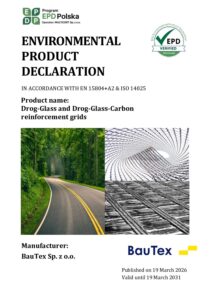
Product Carbon Footprint — ISO 14067

Certify your product's carbon footprint

An independently verified carbon footprint for your product — accepted by your buyers for CSRD, tenders and exports, issued and published by the EPD Polska programme.

Get a quote → How we verify

The documents you receive

A carbon footprint report — the full verified study — and a verification certificate. Climate-focused documents to ISO 14067, distinct from a full EPD, and QR-verifiable in our public register.
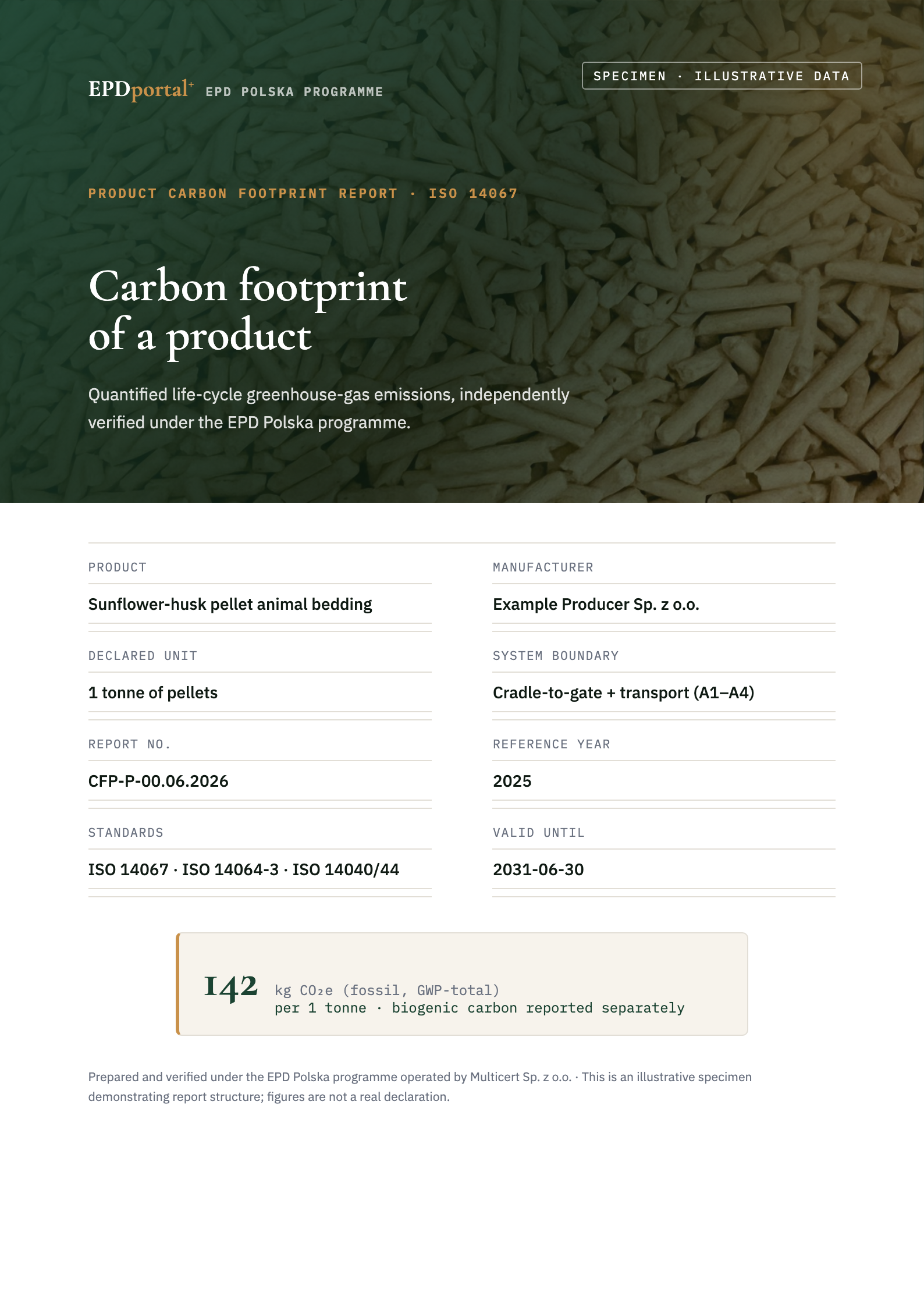
Sample carbon footprint report (specimen)
Carbon Footprint Report — the verified study: result per declared unit, system boundary and contributions by life-cycle stage. ↓ See the full sample (PDF)
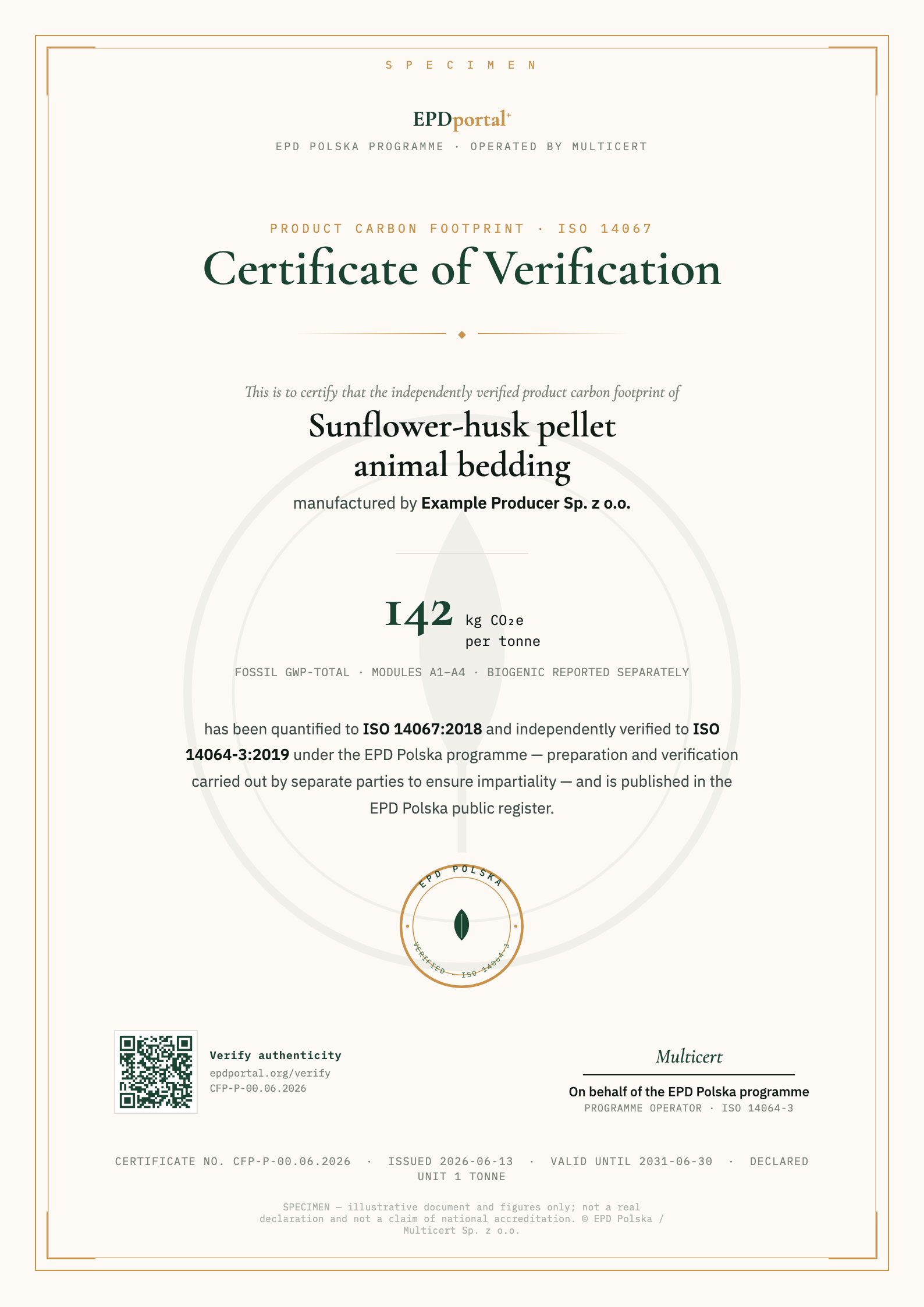
Sample verification certificate (specimen)
Verification Certificate — independent confirmation, with the seal, QR register entry and the verified result. Issued in your buyer's framework: ISO 14067, GHG Protocol, PEF or as an EPD. ↓ See the full sample (PDF)

What's inside the report

So you know exactly what you order — and what we need from you. The report sets out the goal and scope, the system boundary, the primary data you provide, the GWP results per life-cycle module and the independent verification statement.
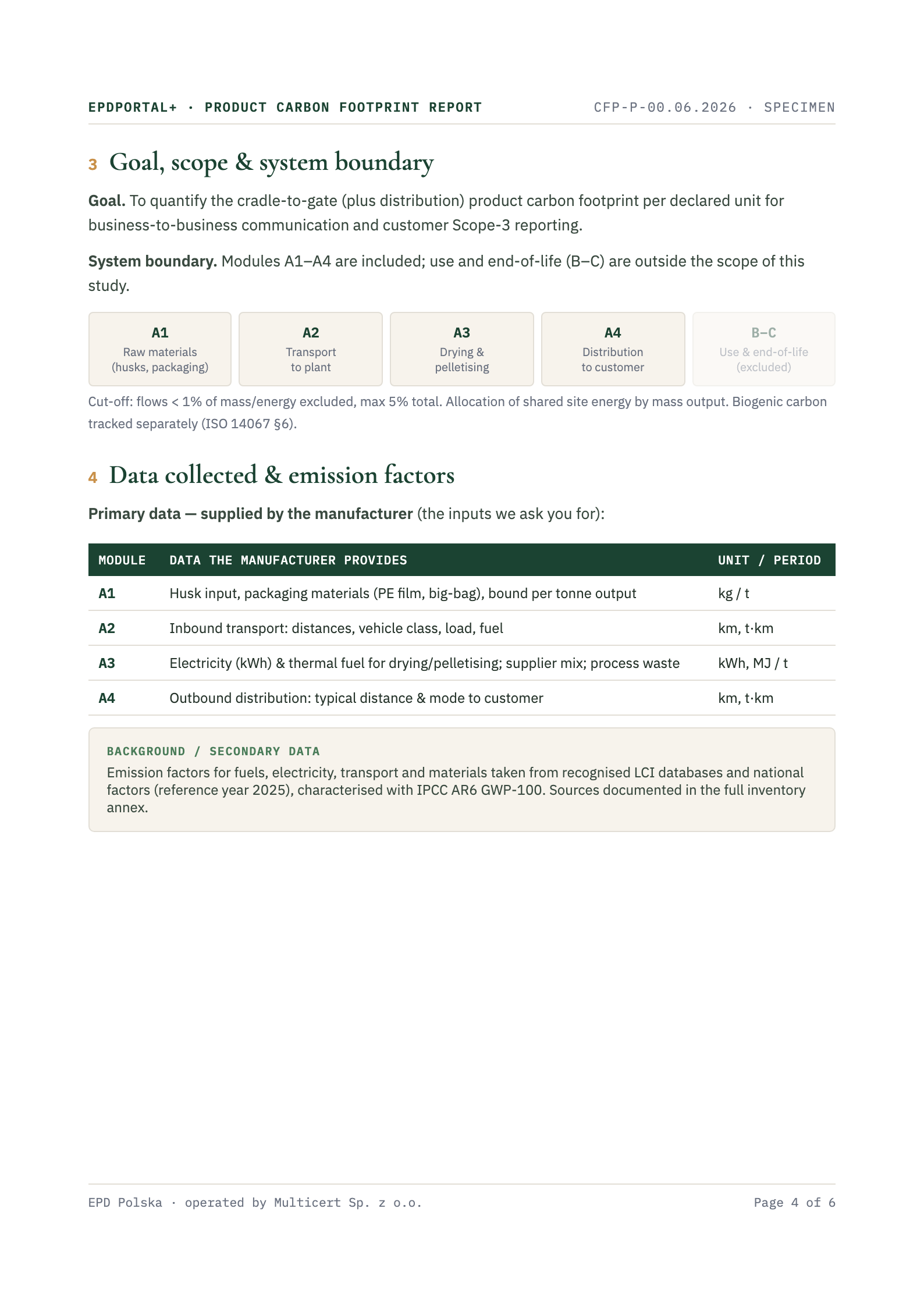
Report page: scope, system boundary and data collected
Scope & data — system boundary (A1–A4) and the primary data we ask the manufacturer to provide for each stage.
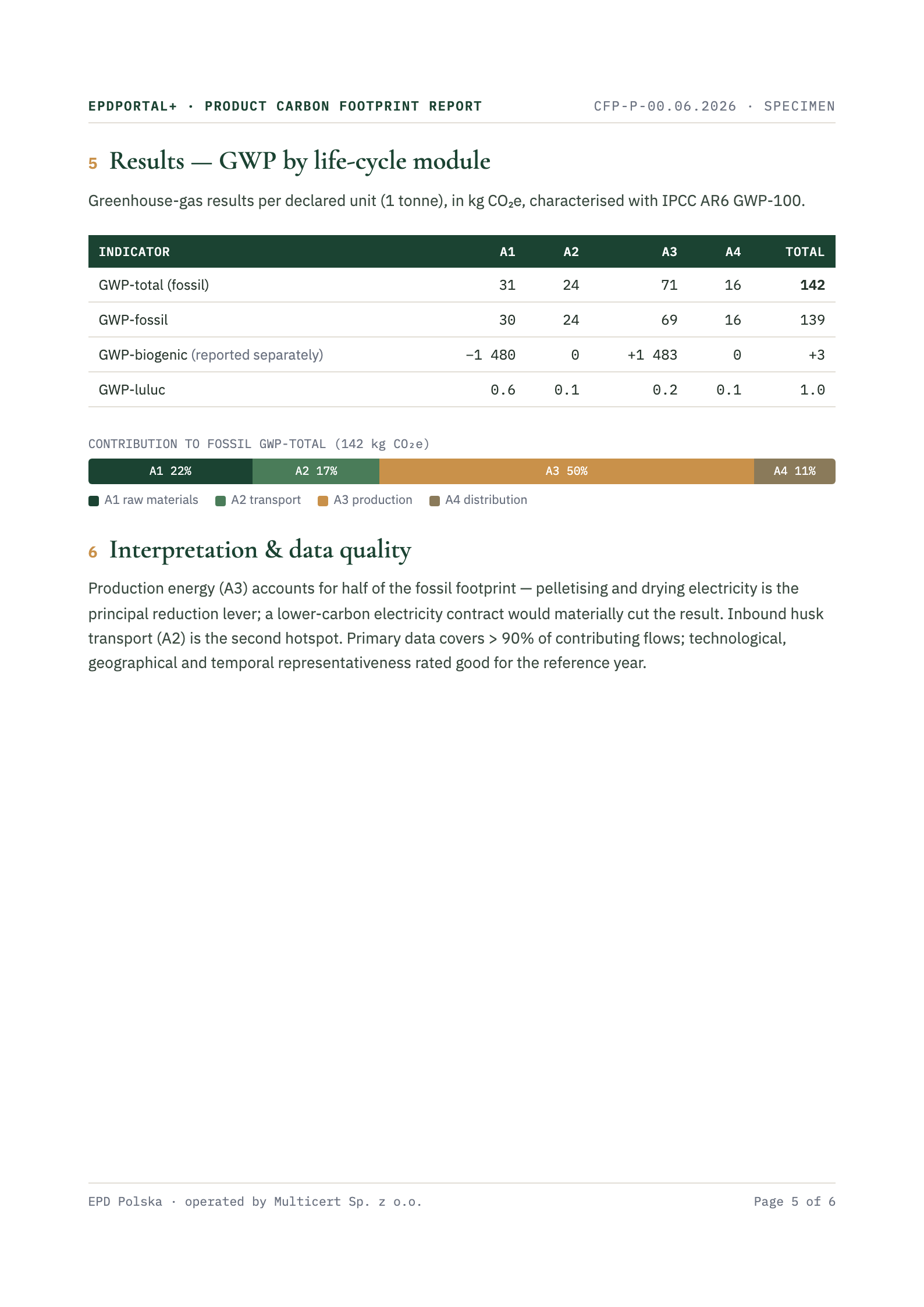
Report page: GWP results by life-cycle module
Results — greenhouse-gas results per declared unit, broken down by module, with the carbon hotspots highlighted.

↓ Open the full sample report (PDF, 6 pages) →

Why your buyers ask for it

01

Large companies must report value-chain (Scope 3) emissions under CSRD — they need verified carbon data from their suppliers.

02

Tenders, retailers and green-building schemes increasingly require an independently verified product carbon footprint.

03

Exports and the EU Digital Product Passport (ESPR, 2026–2030) make verified product-level carbon data the norm.

Two ways we work with you

Verification

You already have a carbon footprint calculation; we verify it independently and issue the certificate.

Report & verification

We prepare the carbon footprint study (LCA) and, by separated teams for impartiality, verify it and issue the certificate.

On what basis we certify

We certify under the EPD Polska programme, operated by Multicert as national programme operator. The footprint is quantified to ISO 14067:2018 (ISO 14040/44 LCA) and independently verified to ISO 14064-3, following our published General Programme Instructions. Verification is independent of those who prepared the data. GWP: IPCC AR6.

The calculation rules — system boundary, declared unit, cut-off and how GWP is counted — follow Product Category Rules, exactly as in an EPD. Where a PCR or c-PCR exists for your product (the same core rules as EN 15804 and any sector c-PCR used in our EPD programme), we apply its carbon-relevant parts, so your footprint is consistent and comparable. Where none exists, we follow ISO 14067's own requirements and our programme rules. How we verify →

The verification is itself documented. To ISO 14064-3 the independent verifier works to a verification plan, gathers and assesses the evidence, and records the findings and their resolution. You receive the verification statement and certificate; the supporting verification records are retained by the programme as an audit trail.

Two documents, two roles. The carbon footprint report is the full study — goal & scope, system boundary, your primary data, GWP per life-cycle module, interpretation — prepared by the LCA practitioner. The verification statement & certificate is the independent verifier’s conclusion to ISO 14064-3, published with a QR-verifiable entry in the public register. Two separate parties.

Backed by Multicert. EPD Polska is operated by Multicert, a certification organisation that also works with internationally recognised certification and testing bodies — LL-C (Certification) for accredited management-system certification and ITC Zlín for product testing. A declaration’s authority rests on the standards applied — ISO 14025, EN 15804+A2, ISO 14067, ISO 14064-3, ISO 14071:2024 — and on independent verification, never self-declaration.

How the footprint is calculated

You provide the production data across the life-cycle stages; we apply the emission factors and verify the result.

Life-cycle stageModuleData you provide
Raw materialsA1quantities, source, supplier data
Transport to siteA2distances, vehicle & fuel
ProductionA3electricity, heat/fuel, packaging, waste
Distribution (optional)A4transport of the finished product

Result: kg CO₂e per declared unit (e.g. 1 t, 1 pc, 1 m²). Biogenic carbon reported separately, per ISO 14067.

Verified declarations in our register

Carbon footprints sit alongside full Environmental Product Declarations in our public register — every one independently verified and permanently published.
Browse the full public register →

Common questions

What manufacturers and their buyers ask most often about a verified product carbon footprint.

How long is the certificate valid, and what about renewal?
Five years from the date of issue, provided there is no significant change. Renewal is a re-verification on current data, which issues a new certificate and a new five-year period.
An earlier update is required if something material changes — the product recipe or bill of materials, the production site or process, your energy supplier or electricity mix, a key raw-material supplier, or a change in the result beyond a set threshold. For buyers reporting under CSRD we also offer an optional annual recalculation, so the carbon data stays current-year while the certificate runs its five years.
Is this accredited certification, or CBAM verification?
It is independent, voluntary verification under the EPD Polska programme, to ISO 14067 and ISO 14064-3. It is not a claim of national accreditation, and it is not CBAM verification — CBAM uses accredited verifiers under the EU ETS/AVR regime, which is a separate process. What you get is a credibly verified footprint, published in our register.
Is a product carbon footprint the same as Scope 1, 2 and 3?
No — and this is a common mix-up. A product carbon footprint (ISO 14067) covers the life cycle of one product, per declared unit. Scope 1/2/3 (GHG Protocol) is your whole company's emissions. They connect: your verified product footprint is exactly the kind of supplier data your customers need for their Scope 3 reporting.
How is it different from an EPD?
An EPD reports many environmental indicators to EN 15804. A product carbon footprint focuses on climate (greenhouse gases) to ISO 14067. Both are independently verified and published in the same register — and a footprint can be issued as a climate-focused document or as a full EPD.
Should I choose an EPD or a product carbon footprint?
Two questions decide it. Is it a construction product, sold into the EU, tenders or green-building schemes? Then an EPD (EN 15804) is usually expected, and the Construction Products Regulation moves construction products towards mandatory environmental declarations. What does your buyer ask for? If they want a single carbon figure or Scope 3 data under the CSRD, a product carbon footprint (ISO 14067) is the faster, lower-cost route. Many manufacturers start with a carbon footprint and add a full EPD when they enter construction. Read the full guide →
According to what rules do you calculate the footprint?
To ISO 14067, with the life-cycle assessment to ISO 14040/44. The calculation rules — system boundary, declared unit, cut-off and how GWP is counted — come from Product Category Rules (PCR), exactly as in an EPD. Where a PCR or c-PCR exists for your product (the same core rules as EN 15804 and any sector c-PCR used in our EPD programme), we apply its carbon-relevant parts, so the result is consistent and comparable. Where none exists, we follow ISO 14067's own requirements and our General Programme Instructions. GWP factors: IPCC AR6. Read the full explanation →
What data do you need from me?
Primary production data for one declared unit: raw materials and packaging (A1), inbound transport (A2), the electricity, fuel and waste of production (A3) and, optionally, distribution (A4). We apply the recognised emission factors and verify the result. If some data is missing we agree conservative assumptions and flag them in the report.
Is my data kept confidential?
Yes. Underlying data is treated as confidential and verification records are retained securely. The declaration itself can be published in the public register, or kept non-public — with validity confirmable on request — for clients who prefer not to disclose life-cycle data.
How much does it cost and how long does it take?
It is quoted individually, because it depends on the product, the data already available and whether you need verification only or a full report. Scoping is free — send your product details and we confirm scope, framework and price. Timelines depend mostly on how ready your data is; verification of an existing footprint is fast, a full report takes longer.
Can I use it to claim my product is "low-carbon" or "carbon neutral"?
The certificate quantifies and independently verifies the number — it does not, by itself, make a marketing claim. A "carbon neutral" claim is a different standard (ISO 14068) and is tightly restricted under the EU Green Claims rules; no offsetting is implied here. Any comparative or "low-carbon" claim must follow the relevant claims rules and be based on the same product category rules.
Will my buyers abroad accept it?
It is built on internationally recognised ISO standards (ISO 14067, ISO 14064-3), independently verified and published in a public register with a QR-verifiable entry — the form buyers expect for B2B and CSRD value-chain data. Final acceptance always depends on your specific buyer's or scheme's requirements, which we are happy to check against your case.

Certify your product carbon footprint

Send your product details and we will confirm the scope, the applicable framework and a quote — scoping is free.

Get a quote →