Introduction: CBAM Is Moving Down the Value Chain
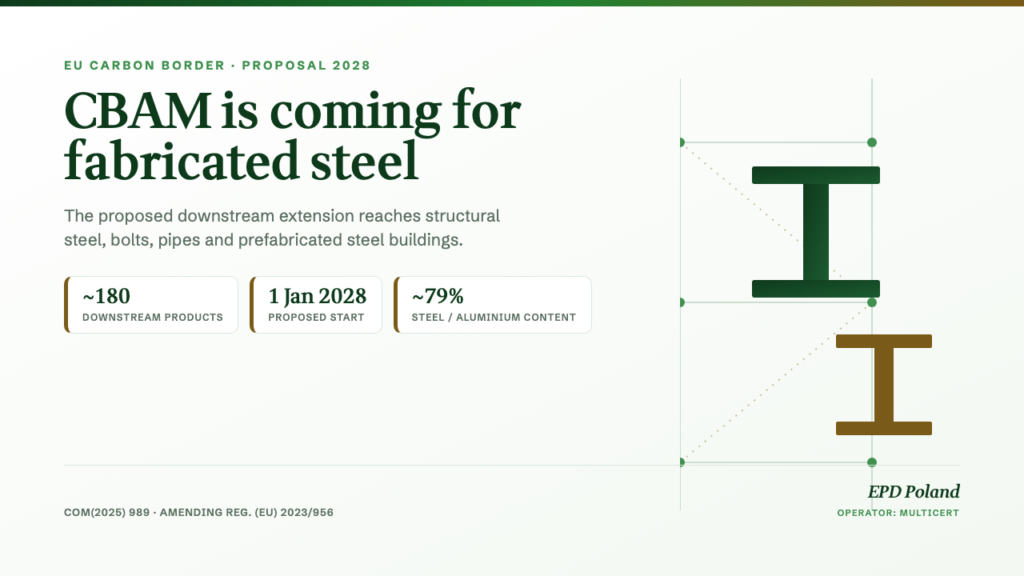
The European Commission has proposed extending CBAM to roughly 180 downstream goods — including structural steel, bolts, pipes and prefabricated steel buildings — from 1 January 2028. If you fabricate with steel, this is the proposal to watch.
For its first years, the EU Carbon Border Adjustment Mechanism (CBAM) has applied to raw and semi-finished steel. That is about to change. On 17 December 2025 the European Commission published a proposal (COM(2025) 989) to extend CBAM down the value chain to fabricated and finished goods that contain steel and aluminium.
This article explains what is proposed, which products are affected, the one mechanic that decides your exposure, and what fabricators should do now — while being clear about what is still only a proposal.
What Is Proposed
The proposal amends the CBAM Regulation (EU) 2023/956 to add around 180 downstream products, selected because they combine a high risk of carbon leakage with a high steel and/or aluminium content (on average about 79% by mass). The extension would apply from 1 January 2028, and the proposal also tightens anti-circumvention rules (for example, treating steel scrap and certain semi-finished inputs as precursors to stop misdeclaration).
Important: this is a proposal. It must pass the EU’s ordinary legislative procedure before it becomes law, so the exact product list and dates may change. But the direction of travel is clear.
Which products would be covered
| Family | Examples in the proposal |
|---|---|
| Iron & steel articles | Structural steel, hollow sections, pipes, sheet piling, railway materials, gas containers |
| Fabricated metal | Screws, bolts, nails, netting and fencing, fittings, stoppers |
| Machinery & equipment | Engines, pumps, cranes, hoists, elevators, robots, motors, transformers, welding equipment, conductors |
| Vehicles & parts | Motor vehicles, chassis, gearboxes, wheels, trailer parts, hand-pushed vehicles |
| Metal furniture & buildings | Metal-framed seats and office furniture, and prefabricated buildings containing steel or aluminium |
Why the Commission Is Going Downstream
The logic is carbon leakage. Once CBAM puts a price on imported raw and semi-finished steel, the cheapest way around that price is to import the finished product instead — a bracket, a bolt, a prefabricated frame — fabricated abroad from high-carbon metal. Extending CBAM to downstream goods closes that gap. The proposal builds directly on the Commission’s Steel and Metals Action Plan of 19 March 2025 and introduces a new concept of “abusive practices” (Article 3(35)) targeting conduct designed to avoid CBAM liability.
Where CBAM Stands in 2026 — the Baseline Being Extended
The downstream proposal sits on top of a regime that is already live. Three dates frame the picture:
- 1 January 2026 — the CBAM definitive period begins. Importers of covered goods need authorised CBAM declarant status and must account for the embedded emissions of what they bring in.
- 1 February 2027 — the sale of CBAM certificates begins. Under the 2025 simplification (the “Omnibus” amendment, in force since 20 October 2025) the first purchases were postponed: declarants buy in 2027 to settle their 2026 emissions.
- 1 January 2028 — the proposed downstream extension would apply.
The same simplification introduced a single 50-tonne mass-based de minimis threshold: importers bringing in 50 tonnes or less of covered goods per year are exempt (hydrogen and electricity excluded). It removes most small importers by headcount while keeping the overwhelming share of emissions in scope — and the downstream extension will pull a fresh population of fabricated-goods importers back toward that line.
The One Mechanic That Decides Your Exposure
This is the point to internalise: for downstream goods, CBAM would attribute embedded emissions only to the steel and aluminium precursors used in the product — not to your fabrication, welding or assembly. In other words, your CBAM exposure is essentially the embedded emissions of the metal you buy.
That has a sharp consequence: your steel supplier’s emissions data becomes your CBAM cost driver. A fabricator who sources low-carbon, electric-arc-furnace steel with verified data will carry a far lower CBAM bill than one who cannot evidence the origin and intensity of their inputs — for an identical finished product.
How Your Downstream Exposure Would Be Calculated
Because exposure tracks the metal, the calculation reduces to two numbers: how much covered steel and aluminium your product contains, and the embedded emission intensity of that metal. You can evidence the second figure in one of two ways:
- Actual, verified data from your supplier’s installation — the route that rewards low-carbon sourcing.
- Default values set by the Commission where actual data is missing — deliberately conservative, so the absence of data tends to cost you.
This is the planning point that matters: defaults are not a neutral fallback. A fabricator who cannot document the origin and intensity of incoming steel will generally be assigned a higher figure than one who can — for physically identical material. Collecting verified supplier data therefore pays for itself twice: once in a lower CBAM position, and again because it is the same primary data an EPD needs.
What This Means for Steel Fabricators
If you manufacture structural steelwork, prefabricated steel buildings, or steel-intensive equipment for the EU market, three things follow:
- Map your steel inputs now. Which mills, which production routes (BF/BOF vs EAF), which countries of origin? This is the data that will drive your 2028 exposure.
- Ask suppliers for verified emissions data, not just mill certificates. The same installation-level data that supports an EPD supports your downstream CBAM position.
- Favour low-carbon, well-documented steel. Where two suppliers are otherwise equal, verified low-carbon steel becomes a measurable cost advantage from 2028.
None of this requires waiting for the law to pass. The data-mapping is useful regardless, and it overlaps with what you already need for EPDs and existing CBAM obligations.
What Happens Next — and When
COM(2025) 989 is a proposal under the ordinary legislative procedure: the European Parliament and the Council must agree a text before it becomes law, so the product list and thresholds can still move in negotiation. But the proposed 1 January 2028 application date gives fabricators a firm planning horizon. Treat 2026–2027 as preparation time, not a waiting room — the supplier-data work is useful under the rules that already apply today.
How EPD Polska / Multicert Can Help
We help fabricators map the embedded emissions of their steel supply chain, collect verified supplier data, and build a single data foundation that serves EPDs and CBAM alike. If the downstream extension affects your products, contact us for a supply-chain exposure review.
FAQ
Is the downstream extension already law?
No. It is a Commission proposal (COM(2025) 989, 17 December 2025) and must complete the ordinary legislative procedure. The proposed start date is 1 January 2028.
Would CBAM tax my fabrication work?
No. The proposal attributes emissions only to the steel and aluminium precursors in the product, not to fabrication or assembly.
I only sell within the EU — am I affected?
CBAM applies to imports into the EU. If you import covered downstream goods, or import the steel you fabricate, the obligation or its cost can reach you. Intra-EU sales of EU-made goods are not themselves subject to CBAM.
What is the single most useful thing to do now?
Map your steel inputs by mill, route and origin, and start collecting verified emissions data from suppliers. See our guide on what CBAM actually costs to model the impact.
How is my exposure calculated if I don’t have supplier data?
The Commission sets conservative default values for embedded emissions where actual data is unavailable. They are deliberately on the high side, so relying on defaults usually means a higher CBAM cost than verified actual data for the same steel.
Does low-carbon (electric-arc-furnace) steel really make a difference?
Yes. Because downstream exposure is driven by the embedded emissions of the metal, electric-arc-furnace steel with verified data typically carries a materially lower CBAM figure than blast-furnace / basic-oxygen steel — for the same finished product.
Official References
- CBAM Legislation and Guidance (incl. the downstream proposal) — DG TAXUD
- Regulation (EU) 2023/956 establishing the CBAM (EUR-Lex)
- CBAM — European Commission (DG TAXUD)
For manufacturers: fabricated-steel producers preparing for this can start with an EPD for steel products, verified to EN 15804+A2.