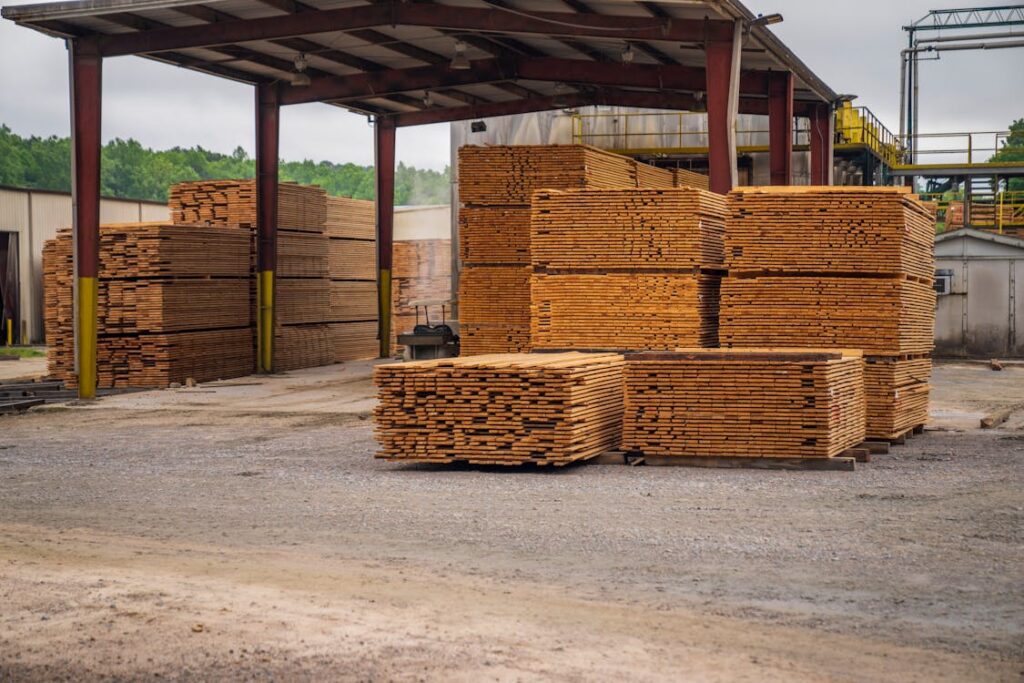
Carbon stored per cubic metre of softwood lumber
Why Wood Deserves Special Attention in EPD Methodology
Wood and timber products occupy a unique position among construction materials. Unlike cement, steel, or mineral insulation, wood is a biogenic material — it originates from living organisms that absorb atmospheric carbon dioxide during their growth phase. A cubic metre of softwood lumber stores roughly 250 kilograms of carbon, which remains locked in the product for as long as the structure stands. This fundamental characteristic has made timber a centrepiece of decarbonisation strategies in the built environment, but it also introduces considerable methodological complexity into Environmental Product Declarations.
The challenge is straightforward in principle yet demanding in practice: how should an EPD account for carbon that enters a product from the atmosphere during raw material growth, remains stored during the product’s service life, and is eventually released when the product reaches end-of-life? The current European standard for construction EPDs, EN 15804+A2, provides a detailed answer. Understanding that answer is essential for timber manufacturers seeking credible declarations, for architects comparing wood-framed options against mineral alternatives, and for specifiers evaluating the genuine climate benefit of timber construction.
What Is Biogenic Carbon and Why Does It Matter?
Biogenic carbon refers to carbon that cycles between the atmosphere and the biosphere through natural processes. Trees absorb carbon dioxide via photosynthesis, converting it into cellulose, hemicellulose, and lignin — the structural polymers that give wood its mechanical properties. When timber is harvested and processed into construction products such as cross-laminated timber (CLT), glulam beams, sawn lumber, or engineered I-joists, the embedded carbon travels from the forest into the built environment. It stays there for decades or even centuries in durable structures.
This temporary removal of carbon from the atmosphere is sometimes described as carbon sequestration, although technically the carbon is stored rather than permanently sequestered. The distinction matters because wood products are not permanent. At end-of-life, whether through incineration, landfill decomposition, or biological decay, the stored carbon returns to the atmosphere as carbon dioxide or methane. A complete environmental assessment must therefore account for both the uptake and the release.
Beware of incomplete claims: Some marketing materials treat wood as inherently carbon-negative without acknowledging the end-of-life release. EN 15804+A2 was specifically designed to prevent such incomplete accounting by requiring transparency across the entire product life cycle.
How EN 15804+A2 Handles Biogenic Carbon
The EN 15804+A2 standard, which became mandatory for all European construction EPDs in July 2022, introduced a dedicated indicator for biogenic carbon flows: GWP-biogenic. This indicator is reported separately from GWP-fossil (emissions from burning fossil fuels) and GWP-luluc (emissions from land use and land-use change). The three sub-indicators, together with GWP-total, provide a disaggregated picture of climate impact that allows users to understand exactly where greenhouse gas flows originate.
| GWP Sub-Indicator | What It Captures | Relevance to Timber |
|---|---|---|
| GWP-fossil | Fossil fuel combustion emissions | Kiln drying, transport, sawing energy |
| GWP-biogenic | Carbon cycling between atmosphere and biosphere | CO₂ uptake in growth; release at end-of-life |
| GWP-luluc | Land use and land-use change | Forestry practices, deforestation risk |
| GWP-total | Sum of all three sub-indicators | Overall climate impact of the product |
Module A1: Biogenic Carbon Uptake
In the product stage, Module A1 covers raw material supply. For timber products, this is where biogenic carbon uptake is recorded. The carbon dioxide absorbed by trees during growth enters the product system as a negative flow in the GWP-biogenic indicator. For example, one cubic metre of kiln-dried spruce lumber might report a GWP-biogenic value of approximately minus 700 to minus 800 kg CO₂-eq in Module A1, reflecting the carbon stored in the wood fibre.
Understanding the negative value: A negative GWP-biogenic in Module A1 does not mean the product has a net negative carbon footprint. It means the biogenic carbon accounting ledger starts with a credit — one that must be balanced by a corresponding debit when the carbon is released at end-of-life.
Modules A2–A5: Manufacturing and Construction
The manufacturing phase (Modules A2 and A3) typically involves fossil fuel combustion for kiln drying, transport energy, and electricity for sawing and planing. These emissions appear under GWP-fossil rather than GWP-biogenic. If wood offcuts or bark are burned as process fuel during manufacturing — a common practice in sawmills — the biogenic carbon release from combustion is recorded in GWP-biogenic for Module A3, partially offsetting the Module A1 uptake. This ensures internal consistency: only carbon that physically remains in the leaving product carries forward as stored biogenic carbon.
Modules B1–B7: Use Stage
During the use stage of a building, timber elements generally maintain their stored carbon without significant biogenic emissions, provided the wood is protected from decay. Module B1 (use) may include a small biogenic carbon release if the product is expected to degrade during service life, but for structural timber protected within a building envelope, this value is typically negligible.
Modules C3 and C4: End-of-Life Release
The end-of-life modules are where biogenic carbon accounting comes full circle. Module C3 (waste processing) covers incineration, and Module C4 (disposal) covers landfill. If wood is incinerated at end-of-life, the stored biogenic carbon is released back to the atmosphere, resulting in a positive GWP-biogenic value that closely mirrors the negative Module A1 value. If wood enters landfill, the decomposition pathway and methane generation introduce additional complexity, but the biogenic carbon is still accounted for as a positive emission.
Why Cradle-to-Grave Scope Is Critical for Wood EPDs
EN 15804+A2 allows EPDs to be declared at different scopes. A cradle-to-gate declaration covers Modules A1–A3 only, while a cradle-to-grave declaration covers all modules including end-of-life. For timber products, the choice of scope has enormous implications for how the results are interpreted.
A cradle-to-gate EPD for a CLT panel might show an impressively negative GWP-biogenic figure, because the biogenic carbon uptake in Module A1 dominates the product stage. Without the end-of-life modules, the carbon release is invisible. A reader unfamiliar with the methodology might conclude that the product permanently removes carbon from the atmosphere. A cradle-to-grave declaration, by contrast, tells the full story: the stored carbon is temporary, and its climate benefit depends on how long it remains in use and what happens at end-of-life.
Scope matters: Building-level assessments and green building certification schemes increasingly require cradle-to-grave EPDs. Manufacturers publishing cradle-to-gate-only declarations for wood products risk having their results misinterpreted as permanent carbon sequestration.
For this reason, building-level assessments and green building certification schemes increasingly require cradle-to-grave EPDs. Architects and engineers comparing a timber frame against a concrete frame need to see the complete picture, not just the production stage. Reputable programme operators insist on transparency about end-of-life assumptions, and manufacturers who publish cradle-to-grave declarations demonstrate confidence in their product’s life-cycle performance.
Comparing Wood With Mineral Construction Materials
The biogenic carbon story gives wood a structural advantage in GWP-biogenic, but it is worth placing this in context. Cement, concrete, and steel have no meaningful biogenic carbon flows. Their climate impact is dominated by GWP-fossil: process emissions from clinker calcination in cement kilns, blast furnace reduction in steelmaking, and energy-related combustion across all manufacturing stages.
When GWP-total is compared at the building element level — say, a timber floor cassette against a hollow-core concrete slab delivering equivalent structural performance — the timber solution often shows lower GWP-total in a cradle-to-grave assessment, particularly when the timber is sourced from sustainably managed forests and the end-of-life scenario includes energy recovery. However, the margin depends heavily on the specific products, transport distances, energy mix, and end-of-life assumptions. EPDs enable precisely this kind of evidence-based comparison, which is why they are so valuable in material selection processes.
Module D: Cascading Use and Reuse Benefits
EN 15804+A2 includes Module D as a supplementary information module that reports benefits and loads beyond the system boundary. For wood products, Module D can capture two important effects. First, if wood is incinerated with energy recovery at end-of-life, the displaced fossil energy is credited in Module D. Second, if wood is reused or recycled into a new product (cascading use), the avoided production of virgin material is reflected.
Module D values are reported separately and must not be added to the A1–C4 total. They provide useful context for decision-makers who want to understand the broader system-level effects of material choices. Timber manufacturers whose products are designed for disassembly and reuse can highlight favourable Module D values as evidence of circular economy alignment — an increasingly important selling point given the European Commission’s Circular Economy Action Plan.
Sustainable Forestry and the GWP-luluc Indicator
EN 15804+A2 introduced the GWP-luluc indicator to capture greenhouse gas emissions associated with land use and land-use change. For wood products, this indicator is directly relevant to forestry practices. Timber sourced from sustainably managed forests where the harvested area is replanted maintains the forest carbon stock over time, resulting in low GWP-luluc values. Timber sourced from forests undergoing net deforestation could carry significant GWP-luluc burdens.
Certification schemes such as FSC and PEFC provide chain-of-custody assurance for sustainable sourcing. While these certifications are not formally required for an EPD, the underlying LCA data for timber should reflect the actual forestry management practices. The Food and Agriculture Organization of the United Nations (FAO) publishes global data on forest resources and sustainable management that provides useful context for understanding regional forestry impacts.
Practical Guidance for Timber Manufacturers
Timber manufacturers considering their first EPD should keep several points in mind. The declared unit or functional unit must be clearly defined — typically one cubic metre of product at a specified moisture content for sawn timber, or one square metre of panel at a specified thickness for CLT and plywood. The LCA dataset must use representative production data, ideally from the manufacturer’s own facility, covering at least one full year of operation.
- Define the declared unit. One cubic metre at specified moisture content for sawn timber, or one square metre at specified thickness for panels (CLT, plywood).
- Collect production data. Use representative data from the manufacturer’s own facility, covering at least one full year of operation.
- Calculate biogenic carbon content. Derived from wood’s dry mass and carbon fraction (~50% of dry mass for most softwood species). Account for moisture content at point of delivery.
- Engage a programme operator. EPD Polska offers a process tailored to the Polish and Central European market with EN 15804+A2 expertise.
- Complete verification and publish. Third-party verification ensures biogenic carbon accounting, end-of-life scenarios, and all results meet the CEN standard.
Biogenic carbon content is calculated from the wood’s dry mass and carbon fraction (approximately 50 percent of dry mass for most softwood species). The moisture content at the point of delivery matters because it determines the amount of biogenic carbon per declared unit. Kiln-dried timber at 12 percent moisture content contains more carbon per kilogram of product than green timber at 30 percent moisture content, simply because a larger fraction of the product mass is wood substance rather than water.
For obtaining a verified EPD, working with an experienced programme operator streamlines the process. EPD Polska operates a programme specifically designed for the Polish and Central European market, with expertise in EN 15804+A2 requirements and direct familiarity with the timber product categories common in the region. The EPD Polska verification process ensures that biogenic carbon accounting is handled correctly, that end-of-life scenarios are transparently declared, and that the resulting EPD meets the requirements of the CEN standard.
The Road Ahead: Timber and the Regulatory Landscape
Get ahead of regulation: While mandatory GWP disclosure under CPR 2024/3110 is not yet in force, forward-thinking timber manufacturers publishing EPDs voluntarily will have established data collection processes, verified LCA models, and published declarations ready to meet new obligations with minimal additional effort.
The revised Construction Products Regulation (CPR 2024/3110) establishes a legal framework under which environmental performance, including greenhouse gas emissions, may eventually become part of the information accompanying construction products placed on the EU market. While mandatory GWP disclosure is not yet in force — it requires new harmonised technical specifications to be published in the Official Journal and the coexistence period to expire — forward-thinking timber manufacturers are already preparing by publishing EPDs voluntarily. When mandatory requirements do arrive, these companies will have established data collection processes, verified LCA models, and published declarations ready to meet the new obligations with minimal additional effort.
The growing demand for sustainable construction, combined with regulatory direction from the EU, means that transparent biogenic carbon accounting is not just a methodological curiosity. It is a commercial necessity for timber manufacturers who want to compete in a market that increasingly demands verifiable environmental data. An EPD built on rigorous EN 15804+A2 methodology, verified by a credible programme operator, is the strongest evidence a timber manufacturer can offer.
Frequently Asked Questions
Does wood have a negative carbon footprint according to EPDs?
Not in the net sense. EN 15804+A2 requires that biogenic carbon uptake in Module A1 is balanced by biogenic carbon release in the end-of-life modules (C3/C4). A cradle-to-gate EPD may show a negative GWP-biogenic value, but a cradle-to-grave declaration will show that the net biogenic carbon balance is close to zero. The fossil emissions from manufacturing and transport (GWP-fossil) must also be considered. Wood products frequently have lower GWP-total than mineral alternatives, but they are not carbon-negative over their full life cycle.
Why does EN 15804+A2 separate GWP into sub-indicators?
The separation into GWP-fossil, GWP-biogenic, and GWP-luluc provides transparency about the sources of climate impact. For wood products, this disaggregation is particularly important because it prevents biogenic carbon uptake from masking fossil emissions. Users can see exactly how much of the climate impact comes from fossil fuel combustion versus biogenic carbon cycling versus land-use effects, enabling more informed material comparisons.
Is a cradle-to-gate EPD sufficient for wood products?
While EN 15804+A2 permits cradle-to-gate EPDs, they present an incomplete picture for biogenic materials because they show carbon uptake without the corresponding end-of-life release. For building-level assessments and most green building rating schemes, cradle-to-grave EPDs are expected or required. Manufacturers publishing cradle-to-gate-only declarations for wood products risk having their results misinterpreted as permanent carbon sequestration.
How does Module D work for timber products?
Module D reports benefits and loads beyond the system boundary. For wood, this typically includes energy credits from incineration with energy recovery and material credits from reuse or recycling into new products. Module D values are always reported separately from the A1–C4 life-cycle results. They inform system-level thinking but cannot be used to reduce the declared environmental impact of the product itself.
Can EPD Polska handle EPDs for engineered timber products like CLT and glulam?
Yes. EPD Polska covers all construction product categories under EN 15804+A2, including engineered wood products such as cross-laminated timber, glulam, laminated veneer lumber, and wood-based panels. The programme’s verification process addresses the specific methodological requirements for biogenic carbon accounting, adhesive emissions, and multi-component wood products.