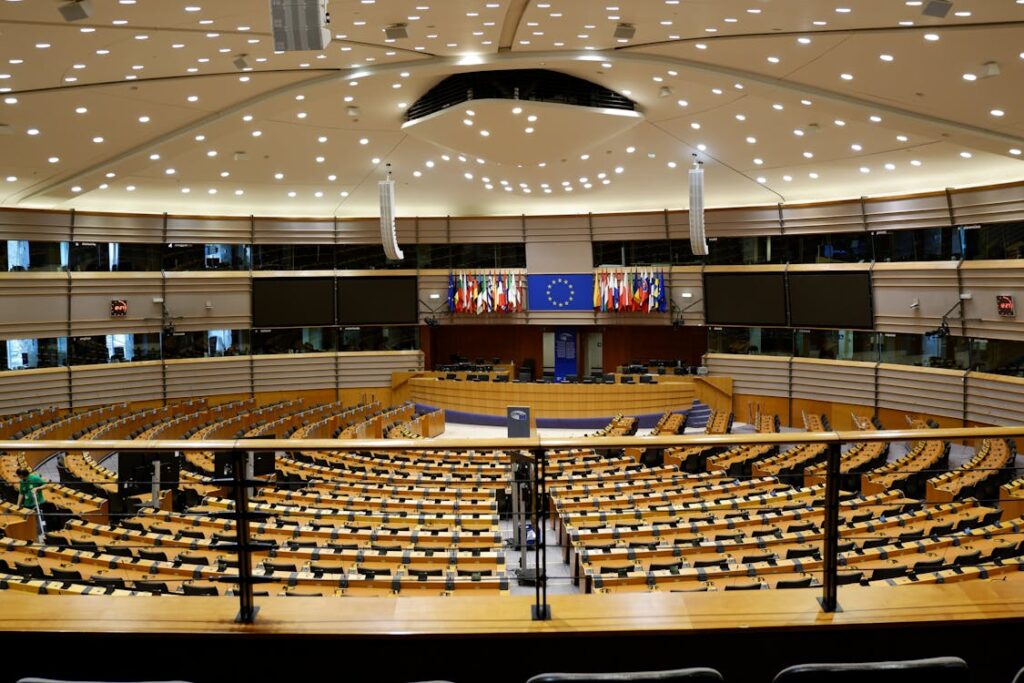
Annual EU public procurement spending on goods, services, and works
The Growing Role of Environmental Criteria in Public Procurement
Public authorities across the European Union collectively spend approximately two trillion euros each year on goods, services, and works. A significant share of this expenditure goes to construction — buildings, roads, bridges, water infrastructure, and renovations of public estates. As the EU intensifies its efforts to meet climate targets, public procurement has become one of the most powerful levers for driving sustainable market transformation. When governments demand lower-carbon materials in their tenders, manufacturers respond. Environmental Product Declarations have emerged as the primary mechanism through which this demand is expressed and verified in the construction sector.
Green Public Procurement (GPP) is the process by which public authorities seek to procure goods, services, and works with a reduced environmental impact throughout their life cycle compared to alternatives that serve the same primary function. The European Commission has been developing GPP criteria for various product groups since 2008, and the construction sector — given its massive resource consumption and carbon emissions — has been a consistent focus. For manufacturers who supply materials to public projects, understanding how GPP works and how EPDs fit into the framework is no longer optional. It is a commercial imperative.
The EU GPP Framework: How It Works
The European Commission’s GPP framework provides voluntary criteria that public authorities can integrate into their tender documents. These criteria are developed for specific product groups — including office buildings, road construction, and water-based infrastructure — and are structured at two ambition levels. Core criteria represent a baseline level of environmental performance that can be adopted with minimal verification effort. Comprehensive criteria are more demanding and are intended for authorities that wish to be at the forefront of environmental procurement.
| Ambition Level | Description | Intended For |
|---|---|---|
| Core criteria | Baseline environmental performance | All public authorities; minimal verification effort |
| Comprehensive criteria | More demanding requirements | Authorities at the forefront of environmental procurement |
The GPP criteria for office buildings, for example, include requirements related to energy performance, material impacts, indoor environmental quality, and life-cycle cost. Within the material impacts category, the criteria reference life-cycle assessment data and specifically mention EPDs as a preferred form of evidence. The 2023 revision of the GPP criteria for office buildings strengthened the link to whole-life carbon assessment, asking procurers to request information on embodied carbon for key building elements — information that can only be provided credibly through product-specific or average-data EPDs.
Awarding Criteria vs Technical Specifications
Public procurement law distinguishes between technical specifications (mandatory requirements that every bid must meet to be considered) and awarding criteria (factors used to evaluate and rank compliant bids). Environmental requirements can appear in either role, and understanding the distinction is important for manufacturers.
Technical Specification
- Mandatory pass/fail requirement
- EPD must accompany the bid
- Non-compliant bids are excluded
- Example: „All structural steel must have a valid EN 15804+A2 EPD”
Awarding Criterion
- Scoring input for bid evaluation
- Typically 10–20% of total score
- Lower embodied carbon = higher score
- EPD provides competitive advantage
When an EPD is referenced as a technical specification, the tender might state that construction products for a given application must be accompanied by a valid EPD conforming to EN 15804+A2. Only bids that include EPDs would be considered compliant. When an EPD is referenced as an awarding criterion, the tender might allocate a percentage of the total score — say ten to twenty percent — to environmental performance, with lower embodied carbon (demonstrated by EPD data) receiving higher scores. In the awarding criteria model, manufacturers with EPDs gain a competitive advantage even if EPDs are not strictly mandatory.
Both approaches are legally permissible under the EU Public Procurement Directives (2014/24/EU and 2014/25/EU), provided the criteria are linked to the subject matter of the contract, are transparent, and are proportionate. National transpositions may add further guidance or requirements.
Level(s): The EU Framework for Sustainable Buildings
The Level(s) framework, developed by the European Commission, provides a common language for assessing and reporting on the sustainability performance of buildings. Level(s) covers six macro-objectives, including greenhouse gas emissions and whole life-cycle environmental impacts, resource-efficient and circular material life cycles, and healthy and comfortable spaces.
The EPD-Level(s) connection: For macro-objective 1 (greenhouse gas emissions over the building life cycle), Level(s) explicitly relies on EPD data as the primary source of product-level environmental information, referencing EN 15804+A2 as the standard for construction product EPDs.
For macro-objective 1 (greenhouse gas emissions over the building life cycle), Level(s) explicitly relies on EPD data as the primary source of product-level environmental information. The framework references EN 15804+A2 as the standard for construction product EPDs and provides guidance on how EPD data feeds into building-level assessments. Public authorities using Level(s) as a basis for their GPP criteria will naturally require or favour materials accompanied by verified EPDs.
Level(s) is not a certification scheme — it is a reporting framework. But its integration into EU GPP criteria, EU taxonomy alignment assessments, and national building regulations means that EPD data is increasingly the currency of sustainable construction procurement. Manufacturers who invest in EPDs today are building the data infrastructure that Level(s) and related frameworks demand.
How EPDs Serve as Evidence in Public Tenders
An Environmental Product Declaration provides third-party-verified environmental data based on life-cycle assessment, formatted according to EN 15804+A2 and published by an accredited programme operator. This combination of standardisation, verification, and transparency makes EPDs uniquely suited to public procurement contexts where objectivity and comparability are paramount.
In a typical GPP tender for a construction project, the contracting authority might require that certain product categories — concrete, steel reinforcement, insulation, windows — be accompanied by product-specific or sector-average EPDs. The GWP-total indicator from the EPD is then used in one of two ways: either as a pass/fail threshold (technical specification) or as a scoring input (awarding criterion). Some tenders go further and require a whole-building life-cycle assessment, in which case EPDs for all major materials feed into a building-level model calculated according to EN 15978.
The advantage of EPDs over alternative forms of environmental evidence — such as self-declarations or marketing claims — is their rigour. An EPD undergoes independent verification by a qualified third-party verifier, ensuring that the underlying LCA follows the relevant product category rules, uses representative data, and reports results in a standardised format. Public authorities can rely on EPD data without needing in-house LCA expertise to validate each claim. This is precisely why the distinction between an EPD and a self-declaration matters so much in procurement.
National Implementation: Poland and the Public Procurement Law
In Poland, public procurement is governed by the Prawo zamówień publicznych (PZP) — the Public Procurement Law, which transposes the EU directives into national legislation. The Urząd Zamówień Publicznych (Public Procurement Office) oversees implementation and provides guidance to contracting authorities.
Polish GPP uptake has been growing, driven in part by EU funding requirements for major infrastructure projects. When EU structural funds co-finance a construction project, the funding conditions often include sustainability criteria that align with EU GPP guidance. This creates a direct channel through which EPD requirements enter Polish public procurement. Motorway construction, public building renovation programmes, and municipal infrastructure projects have all seen tenders with environmental performance criteria referencing life-cycle data.
For Polish manufacturers, this means that having EPDs is increasingly relevant not just for export markets in Scandinavia and Western Europe (where GPP is more advanced) but also for domestic public contracts. The trend is clear: environmental criteria in Polish public tenders will become more common as the country aligns more closely with EU GPP ambitions. Manufacturers who obtain EPDs through EPD Polska position themselves to respond to these requirements immediately, without delays for declaration preparation when a tender opportunity arises.
The Competitive Advantage of Holding EPDs
Beyond meeting minimum requirements, EPDs confer strategic advantages in competitive tendering. Consider a scenario where two manufacturers bid for a concrete supply contract on a public building project. Both meet the technical specifications for strength class and durability. The tender allocates fifteen percent of the evaluation score to environmental performance, assessed using GWP-total per functional unit. Manufacturer A holds a product-specific EPD showing GWP-total of 280 kg CO₂-eq per cubic metre. Manufacturer B has no EPD and submits generic industry data showing 340 kg CO₂-eq per cubic metre. Manufacturer A scores higher on the environmental criterion and, all else being equal, wins the contract.
This competitive dynamic is already playing out across Northern Europe and is spreading southward and eastward as GPP adoption accelerates. The manufacturers who gain the most are those who obtain EPDs before their competitors, establishing environmental credentials that become a bidding advantage in every tender that includes sustainability criteria.
The cost of obtaining an EPD — typically several thousand euros for the LCA study and verification, plus a modest annual registration fee — is modest relative to the value of public contracts that can be won or lost on environmental performance scores. For most manufacturers, the return on investment becomes positive after winning a single contract where the EPD contributed to a higher evaluation score.
Cost-Benefit Considerations for Manufacturers
Manufacturers sometimes hesitate to invest in EPDs because they perceive the cost as high relative to uncertain benefits. A practical cost-benefit analysis should consider several factors. The direct cost of an EPD includes the LCA study (which can often be conducted for a group of similar products), third-party verification, and programme operator registration. For a medium-sized manufacturer producing a defined range of products, the total cost for a first EPD typically ranges from five to fifteen thousand euros, with renewals significantly less expensive because the LCA model already exists.
| Factor | Details |
|---|---|
| First EPD cost | €5,000–15,000 (LCA study + verification + registration) |
| Renewal cost | Significantly lower — LCA model already exists |
| GPP tender access | Required or strongly preferred in growing number of tenders |
| Green building certification | Rewarded by BREEAM, DGNB, and similar schemes |
| EU Taxonomy alignment | Supports EU Taxonomy screening for sustainable activities |
| CPR preparedness | Ready for anticipated CPR 2024/3110 requirements |
The benefits side of the equation includes access to GPP tenders that require EPDs, higher scores in tenders that reward environmental performance, eligibility for green building projects seeking BREEAM or DGNB certification (both of which reward materials with EPDs), alignment with the EU Taxonomy for sustainable activities, and preparedness for the environmental transparency requirements anticipated under CPR 2024/3110. Taken together, these benefits represent a significant and growing market opportunity.
Practical Steps: From No EPD to Winning Green Tenders
- Identify the target product. Select the product or product group for which an EPD would deliver the greatest commercial benefit — typically the product with the highest sales volume into public or green-certified projects.
- Commission the LCA study. Engage an LCA practitioner to conduct the study, using the manufacturer’s own production data to ensure the EPD reflects actual performance rather than generic averages.
- Select a programme operator. EPD Polska offers a process tailored to Polish manufacturers with support in the local language, producing internationally recognised EN 15804+A2 declarations.
- Complete verification and publish. Third-party verification and EPD publication through the programme operator.
- Integrate into commercial workflows. Use the EPD in tender responses, commercial documentation, and marketing materials.
Once the first EPD is published, subsequent declarations for related products become faster and less expensive because the LCA methodology, data collection systems, and verification relationships are already established. Many manufacturers find that the EPD process also yields operational insights — identifying energy-intensive steps or waste streams that can be optimised for both environmental and cost performance.
Looking Forward: GPP and the European Green Deal
Prepare now: Proposed revisions to the EU public procurement directives are expected to strengthen environmental requirements, moving from voluntary GPP criteria toward mandatory minimum environmental standards for certain high-impact product categories. Construction materials are likely to be among the first affected.
The European Green Deal and the Fit for 55 legislative package have reinforced the EU’s commitment to using public procurement as a tool for climate action. Proposed revisions to the public procurement directives are expected to strengthen environmental requirements further, moving from voluntary GPP criteria toward mandatory minimum environmental standards for certain high-impact product categories. Construction materials are likely to be among the first categories affected.
Manufacturers who view EPDs as a one-time compliance exercise are missing the larger picture. EPDs are becoming the common data format for environmental performance in construction — used in GPP, green building certification, EU Taxonomy screening, CSRD reporting, and, eventually, regulatory compliance under the CPR. Investing in EPDs now is investing in the data infrastructure that the entire European construction market is converging on.
Frequently Asked Questions
Are EPDs mandatory for public procurement in the EU?
Not universally. The EU GPP criteria are voluntary, and member states implement them at different levels of ambition. However, an increasing number of public tenders — especially for large projects, EU-funded projects, and projects in member states with advanced GPP policies — include requirements or awarding criteria that reference EPDs. In practice, not having an EPD can exclude a manufacturer from significant market segments.
Can a self-declared environmental claim replace an EPD in a public tender?
In most GPP-aligned tenders, no. Public procurement law requires that evidence be objective, verifiable, and non-discriminatory. A third-party-verified EPD meets these criteria; a manufacturer’s own environmental claim generally does not. Some tenders accept alternative evidence if it provides equivalent assurance, but an EN 15804+A2-compliant EPD is the most widely accepted and least disputed form.
How does Level(s) relate to GPP for construction?
Level(s) provides the assessment methodology that underpins EU GPP criteria for buildings. When a public authority uses Level(s)-aligned criteria in a tender, they are effectively requiring the type of life-cycle environmental data that EPDs provide. Level(s) macro-objective 1 (greenhouse gas emissions) relies directly on EN 15804+A2-compliant EPD data for building-level carbon assessment.
Do Polish public tenders already require EPDs?
Some do, particularly large infrastructure projects co-funded by EU structural funds and projects seeking green building certification. The trend toward including environmental criteria in Polish public tenders is accelerating. Manufacturers who obtain EPDs through EPD Polska are prepared to respond to these requirements immediately, gaining an advantage over competitors who would need months to produce a declaration.
What is the typical return on investment for an EPD in the context of public procurement?
The ROI depends on the manufacturer’s market position and the volume of public contracts they pursue. However, the cost of an EPD (typically five to fifteen thousand euros for a first declaration) is very small relative to the value of public construction contracts. Winning even one additional contract, or scoring higher on environmental criteria to secure preferred supplier status, typically recovers the EPD investment many times over.