Poland’s Circular Economy Opportunity in Construction
Tonnes of industrial and construction waste processed in Poland annually
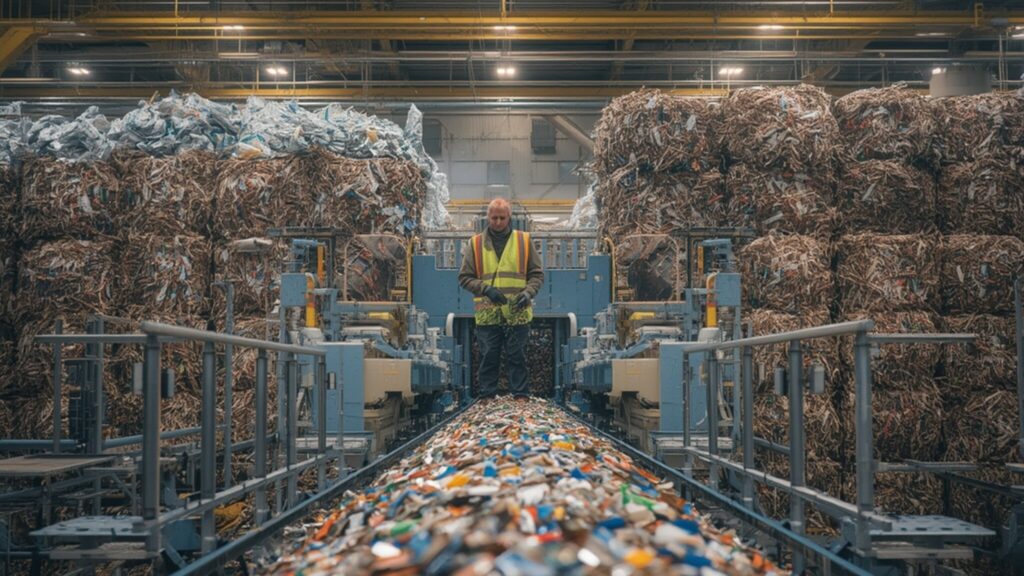
Poland processes over 130 million tonnes of industrial and construction waste annually, a significant portion of which has the potential to re-enter the construction supply chain as secondary raw materials. Recycled concrete aggregates, steel slag aggregates, fly ash for cement production, recycled plastic insulation, and reclaimed timber all represent materials that can displace virgin resources while reducing landfill volumes and extraction pressures. The European Commission’s Circular Economy Action Plan explicitly targets construction as a priority sector, recognising that buildings and infrastructure consume approximately half of all extracted materials in Europe.
For Polish waste management companies and recyclers, the construction market presents a substantial commercial opportunity. But accessing that market — particularly the higher-value segments of green building projects, public procurement tenders with environmental criteria, and cross-border exports — requires demonstrating that recycled products meet both technical performance standards and environmental claims. Environmental Product Declarations provide exactly this demonstration. An EPD for a recycled construction product is a verified, standardised statement of its environmental performance that allows specifiers, contractors, and regulators to compare it on equal terms with virgin alternatives.
This article explores how EPDs work for recycled construction materials under EN 15804+A2, why Module D is particularly important for circular products, what end-of-waste criteria mean for CE marking and EPDs, and how Polish manufacturers can access the EPD process through the national programme operator.
Recycled Materials in Polish Construction: The Current Landscape
Poland’s construction sector has grown rapidly over the past two decades, creating both demand for materials and significant demolition waste streams. Several recycled material categories are already established or emerging in the market.
| Material Category | Source | Applications | Governing Standard |
|---|---|---|---|
| Recycled concrete aggregate (RCA) | Demolition rubble | Road sub-bases, concrete, fill | EN 12620, EN 13242 |
| Slag aggregates (GGBS) | Steel industry (Silesia) | Blended cements, road construction | EN 15167-1 |
| Recycled polystyrene insulation | Post-consumer/industrial EPS/XPS | Thermal insulation | EN 13163 |
| Fly ash | Coal-fired power plants | Pozzolanic addition in cement/concrete | EN 450-1 |
Recycled Concrete Aggregates
Demolition of concrete structures produces rubble that, after crushing and screening, yields recycled concrete aggregate (RCA). Polish aggregate producers are increasingly processing RCA to meet technical requirements for use in road sub-bases, concrete production, and fill applications. The technical performance of RCA is governed by EN 12620 (aggregates for concrete) and EN 13242 (aggregates for unbound and hydraulically bound materials), and CE marking under the Construction Products Regulation is required for placement on the EU market.
Slag Aggregates
Poland’s steel industry, centred in Silesia and other industrial regions, produces significant quantities of blast furnace slag and electric arc furnace slag. Ground granulated blast furnace slag (GGBS) is used as a supplementary cementitious material in blended cements, directly reducing clinker content and associated CO2 emissions. Steel slag aggregates are used in road construction and as fill material. Both product types carry favourable environmental profiles compared to virgin alternatives — a story that EPDs can quantify and verify.
Recycled Plastics in Insulation
Expanded polystyrene (EPS) and extruded polystyrene (XPS) insulation can incorporate recycled polystyrene content. Some Polish insulation manufacturers have begun marketing products with post-consumer or post-industrial recycled content, appealing to green building specifiers. An EPD documenting the reduced virgin resource consumption and potentially lower manufacturing energy (depending on the recycling process) provides credible evidence for these claims.
Fly Ash and Other Industrial By-products
Poland’s coal-fired power sector generates substantial quantities of fly ash and bottom ash. Fly ash is widely used as a pozzolanic addition in cement and concrete production. While fly ash use in concrete is well-established and covered by EN 450-1, its environmental benefits — avoided landfill, reduced clinker demand — can be quantified through LCA studies and documented in EPDs for the blended cement or concrete that incorporates it.
EN 15804+A2 and Recycled Products: Module D Explained
Module D is key for circular products: It captures the net environmental benefits that result from material or energy flows leaving the product system and entering other product systems — such as the avoided burden of virgin material production displaced by recycled content.
The EN 15804+A2 standard structures the life cycle of construction products into modules: A1–A3 (production), A4–A5 (construction), B1–B7 (use), C1–C4 (end-of-life), and Module D (benefits and loads beyond the system boundary). For recycled construction materials, Module D is the most strategically important element.
Module D captures the net environmental benefits (or loads) that result from material or energy flows leaving the product system and entering other product systems. When a construction product is made from recycled content, the avoided burden of producing virgin material is allocated partly within the system boundary (as reduced A1 impacts) and partly beyond the system boundary (as Module D credits, depending on the allocation methodology and whether the recycled material displaces a primary production route in a downstream system).
| Life-Cycle Module | Scope | Relevance for Recycled Products |
|---|---|---|
| A1–A3 | Production (raw materials, transport, manufacturing) | Reflects lower impacts from using waste feedstock instead of virgin extraction |
| A4–A5 | Construction (transport to site, installation) | Generally comparable to virgin products |
| B1–B7 | Use stage (maintenance, repair, replacement) | Product-dependent; not typically different for recycled materials |
| C1–C4 | End of life (demolition, transport, processing, disposal) | Product-dependent; may include recyclability of output |
| Module D | Benefits beyond system boundary | Credits for avoided virgin production — the circular economy payoff |
The precise allocation rules follow the EN 15804+A2 end-of-life allocation procedure, which uses a „polluter pays” principle: the product system that generates waste bears the burdens of waste processing, while the product system that uses secondary material receives credits for avoided virgin production. For recycled aggregate producers, this means that the A1 module of their EPD reflects the environmental burden of collecting, transporting, and processing the demolition waste into aggregate — typically a significantly lower burden than quarrying, crushing, and processing virgin stone.
Module D then captures the system-level benefit: by producing aggregate from demolition waste rather than extracting virgin material, the recycler avoids the environmental impacts of quarrying. This Module D value is reported separately from the A1–C4 results and cannot be added to them, but it provides powerful supplementary information that specifiers and building assessors use when evaluating circular economy performance.
How EPDs Demonstrate the Environmental Benefits of Recycled Products
An EPD for a recycled construction material tells a specific quantitative story. Consider a hypothetical EPD for recycled concrete aggregate produced by a Polish demolition contractor who operates a crushing and screening facility.
kg CO2-eq/tonne: typical GWP range for recycled vs virgin crushed rock aggregate
The EPD’s A1–A3 modules would report the GWP-total of collecting demolition waste, transporting it to the processing site, crushing and screening the rubble, and quality testing the output product. This GWP-total might be, for example, 4 to 8 kg CO2-eq per tonne — compared to 5 to 15 kg CO2-eq per tonne for virgin crushed rock aggregate from a typical quarry operation (values vary significantly by site and transport distances).
The EPD would also report other environmental indicators: acidification potential, eutrophication potential, resource depletion, water use, and waste generation. In many of these categories, recycled aggregates perform comparably or favourably relative to virgin materials, particularly when transport distances are shorter (demolition sites are often in urban areas near construction demand, while quarries may be remote).
Module D would show the avoided quarrying impacts — a negative (beneficial) value reflecting the environmental burden of virgin aggregate production that the recycled product displaces. For specifiers using building-level assessment tools that incorporate Module D, this credit directly improves the circular economy score of the building.
Commercial power of EPDs: Without an EPD, a recycled aggregate producer can claim environmental benefits only verbally or through marketing assertions. With an EPD, the claims are verified by an independent third party, expressed in standardised indicators, and directly comparable with EPDs for competing products — whether virgin or recycled.
End-of-Waste Criteria and CE Marking
A critical legal issue for recycled construction materials is the end-of-waste determination. Under the Waste Framework Directive (2008/98/EC), a material ceases to be waste when it has undergone a recovery operation, meets specific criteria for the substance or product category, has a market or demand, and meets applicable technical standards and legislation. Once a material achieves end-of-waste status, it is a product — and as a product, it falls under the Construction Products Regulation if it is intended for permanent incorporation into construction works.
In Poland, end-of-waste decisions are administered by the relevant environmental authorities, including regional environmental inspectorates and the Glowny Inspektorat Ochrony Srodowiska (GIOS) — the Chief Inspectorate of Environmental Protection. Manufacturers of recycled construction materials must navigate both the waste regulatory framework (to achieve end-of-waste status) and the construction products framework (to achieve CE marking for the resulting product).
EPD vs CE marking: An EPD does not replace CE marking — the two serve different purposes. CE marking demonstrates compliance with essential performance characteristics. An EPD provides environmental performance data. However, a recycled aggregate carrying both offers specifiers a complete evidence package for technical and environmental performance.
Under the revised CPR, environmental information may eventually become part of the mandatory information accompanying construction products, further strengthening the complementarity between CE marking and EPDs.
The Market Case for EPDs on Recycled Materials
The commercial argument for EPDs on recycled construction materials is strong and growing. Several market forces create demand for verified environmental data on circular products.
| Market Driver | How EPDs Unlock Value |
|---|---|
| Green building certification (BREEAM, DGNB, HQE) | Award credits for materials with EPDs and recycled content — EPDs directly contribute to project certification scores |
| Green public procurement (GPP) | Tenders increasingly favour lower environmental footprints — EPDs provide formal proof that recycled materials qualify |
| CSRD corporate sustainability reporting | Contractors/developers can quantify circular procurement benefits with EPD data in their sustainability reports |
| Cross-border export markets | EPDs conforming to EN 15804+A2 are internationally recognised, enabling market access beyond Poland |
Green building certification schemes — including BREEAM, DGNB, and HQE — award credits for using materials with EPDs and for incorporating recycled content. A recycled aggregate producer with an EPD can directly contribute to a project’s certification score, making their product more attractive to contractors working on certified buildings.
Public procurement with environmental criteria, as discussed in our article on GPP and EPDs, increasingly favours materials with lower environmental footprints. Recycled materials often have inherently lower embodied carbon than virgin equivalents, but without an EPD, this advantage cannot be formally demonstrated in a tender evaluation.
Corporate sustainability reporting under the CSRD requires large companies to report on resource use and circular economy metrics. Contractors and developers purchasing recycled materials with EPDs can quantify the environmental benefit of their circular procurement choices in their sustainability reports — a data point that generic claims about „using recycled materials” cannot provide.
Finally, the steel sector provides a precedent. Electric arc furnace steelmakers using high recycled content have leveraged EPDs to demonstrate their environmental advantage over primary production routes, gaining market share in green building projects. The same strategy is available to producers of recycled aggregates, slag products, and other secondary materials.
EPD Polska: Supporting Polish Recyclers
EPD Polska operates a programme specifically designed for the Polish market, with the technical expertise to handle the methodological complexities of recycled product EPDs. These complexities include correct application of the EN 15804+A2 allocation rules for secondary materials, proper characterisation of the waste input (including any contamination processing), and transparent declaration of Module D credits.
For Polish waste management companies and recyclers considering their first EPD, the process begins with selecting the product and functional or declared unit, collecting representative production data (energy consumption, transport distances, processing yields, emissions monitoring data), conducting the LCA study, and undergoing third-party verification. EPD Polska provides guidance through each step and publishes the resulting declaration in a format that is internationally recognised under EN 15804+A2.
Regulatory Drivers and Future Outlook
Several regulatory developments strengthen the case for EPDs on recycled construction materials. The Circular Economy Action Plan targets construction specifically, calling for increased recycled content in building materials and improved end-of-life management of construction waste. The revised Waste Framework Directive is expected to strengthen end-of-waste criteria and encourage member states to develop clear pathways for waste-to-product transitions.
The revised CPR establishes a framework for requiring environmental information alongside construction products. While mandatory GWP disclosure is not yet active (it awaits new harmonised technical specifications), the regulatory direction is clear: environmental performance transparency is coming. Recycled material producers who have already established their environmental credentials through EPDs will face a smoother transition when mandatory requirements arrive.
Poland’s National Waste Management Plan and related strategic documents increasingly emphasise circular economy objectives. National funding programmes for waste processing infrastructure often include sustainability criteria that favour projects demonstrating measurable environmental benefits — benefits that EPDs can quantify. Recyclers seeking public co-financing for facility upgrades or capacity expansion can strengthen their applications by demonstrating that their products carry verified environmental credentials.
Practical Recommendations for Polish Recyclers
- Confirm end-of-waste status. Ensure the recycled product has achieved or can achieve end-of-waste status under Polish environmental law. Without this, the material remains legally classified as waste and cannot be CE marked or accompanied by an EPD as a construction product.
- Ensure compliance with the relevant harmonised standard. The product must meet the appropriate standard for its intended application (e.g., EN 12620 for concrete aggregates, EN 13242 for unbound aggregates, EN 13043 for road construction aggregates). CE marking is the baseline market access requirement.
- Collect at least one year of representative production data. This includes energy consumption (electricity and fuels), raw material inputs (including the waste feedstock), transport distances, processing yields, emissions to air and water, and waste outputs. The more complete and accurate the data, the more representative and credible the resulting EPD.
- Engage with EPD Polska and an experienced LCA practitioner. EPD Polska ensures the declaration meets EN 15804+A2 requirements and the verification process is robust.
- Use the published EPD actively in marketing and sales. Include it in tender documentation, product datasheets, BIM objects, and sustainability communications. An EPD sitting on a shelf delivers no value; an EPD integrated into commercial processes drives market access and competitive advantage.
Frequently Asked Questions
Can recycled construction materials have EPDs?
Yes. Any construction product that meets the relevant technical standards can have an EPD, regardless of whether it is made from virgin or recycled raw materials. EN 15804+A2 includes specific allocation rules for secondary materials and provisions for Module D reporting of recycling benefits. Many recycled products show favourable environmental profiles compared to virgin alternatives, which makes EPDs a particularly valuable tool for demonstrating competitive environmental performance.
What is Module D and why is it important for recycled materials?
Module D reports environmental benefits and loads beyond the product system boundary. For recycled construction materials, Module D captures the avoided environmental burden of virgin material production that the recycled product displaces. While Module D values are reported separately from the main life-cycle results (A1–C4), they provide important supplementary information for building-level assessments and circular economy evaluations. They quantify the system-level benefit of using recycled materials.
Do recycled construction materials still need CE marking?
Yes. Once a material achieves end-of-waste status, it is legally a product and must comply with all applicable product regulations, including the Construction Products Regulation if it is intended for permanent incorporation into construction works. CE marking demonstrates compliance with essential performance characteristics. An EPD is complementary — it provides environmental performance data. Both are needed for full market access.
What are end-of-waste criteria and how do they affect EPDs?
End-of-waste criteria define the conditions under which a material ceases to be classified as waste and becomes a product. Under the Waste Framework Directive, these criteria relate to completion of a recovery operation, existence of market demand, compliance with applicable standards, and absence of adverse environmental or health effects. A material must achieve end-of-waste status before it can be CE marked and before an EPD can be published for it as a construction product. In Poland, the relevant environmental authorities administer end-of-waste determinations.
How does EPD Polska support manufacturers of recycled construction materials?
EPD Polska provides the full programme operator service for recycled material EPDs: guidance on product category rules, coordination of third-party verification, and publication of the declaration. The programme has experience with the specific methodological issues that arise for recycled products, including secondary material allocation under EN 15804+A2, Module D calculation for avoided virgin production, and transparent declaration of waste feedstock characteristics. EPDs published through EPD Polska are internationally recognised and conform to EN 15804+A2.