of concrete produced globally each year — making it the second most consumed substance after water
Why LCA Matters for Cement and Concrete
Cement and concrete form the backbone of modern construction. Globally, concrete is the second most consumed substance after water, with an estimated 14 billion cubic metres produced each year. Cement production alone accounts for approximately 7 percent of global anthropogenic CO₂ emissions — a figure that exceeds the entire aviation industry. In the context of climate policy, decarbonising cement and concrete is not optional; it is one of the most critical industrial challenges of the coming decades.
Life Cycle Assessment, governed by the international standards ISO 14040 and ISO 14044, provides the methodological framework for quantifying the environmental impacts of products across their entire life cycle — from raw material extraction through manufacturing, use, and end-of-life disposal or recycling. For cement and concrete, LCA is the analytical engine behind Environmental Product Declarations, and it provides the data that architects, engineers, specifiers, and regulators need to make informed decisions about material selection and building design.
Understanding how LCA is applied to cement and concrete requires appreciating the distinct characteristics of each material, their different system boundaries, and the key variables that drive their environmental profiles.
Cement vs. Concrete: A Fundamental Distinction
Do not confuse cement and concrete. Cement is a fine powder binder — an intermediate product never used alone. Concrete is the final composite material made from cement, water, aggregates, and admixtures. Confusing the two leads to analytical errors and misleading environmental comparisons.
Before examining LCA methodology, it is essential to clarify the distinction between cement and concrete, because confusion between the two leads to analytical errors and misleading comparisons.
Cement is a fine powder — a binder — produced by burning limestone and clay in a kiln at approximately 1,450°C to form clinker, which is then ground with a small amount of gypsum and, in blended cements, with supplementary cementitious materials. Cement is never used alone in construction; it is an intermediate product.
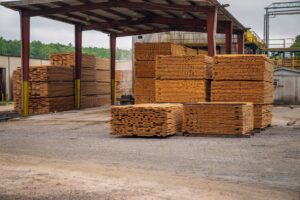
Concrete is a composite material made by mixing cement with water, fine aggregate (sand), coarse aggregate (gravel or crushed rock), and often chemical admixtures. Concrete is the final construction product — the material that is poured, compacted, cured, and becomes a structural or non-structural element of a building or infrastructure.
Cement
- Fine powder binder (intermediate product)
- Produced by burning limestone + clay at ~1,450°C
- System boundary: quarry to finished powder
- Declared unit: per tonne
- GWP dominated by calcination + kiln fuel
Concrete
- Composite construction material (final product)
- Made from cement + water + aggregates + admixtures
- System boundary: all inputs to batching plant
- Declared unit: per cubic metre (strength class)
- GWP dominated by cement content (70–90%)
The distinction matters for LCA because cement and concrete have different system boundaries, different functional units, different environmental profiles, and different opportunities for impact reduction. An LCA of cement examines the production of the binder; an LCA of concrete examines the production of the composite material, in which cement is one input among several.
System Boundaries for Cement (Modules A1–A3)
Under EN 15804+A2, the production stage of a construction product is captured in modules A1 (raw material supply), A2 (transport to the manufacturing plant), and A3 (manufacturing). For cement, these modules encompass the following processes.
Module A1: Raw Material Extraction
The primary raw materials for Portland cement clinker are limestone (calcium carbonate, CaCO₃) and clay or shale (providing silica, alumina, and iron oxide). These are quarried from open-pit mines, typically located adjacent to the cement plant. Module A1 covers the environmental impacts of quarrying operations: energy for drilling, blasting, crushing, and initial material handling; land use changes associated with quarry expansion; and any dust or water emissions from quarrying activities.
For blended cements, Module A1 also includes the supply of supplementary cementitious materials (SCMs): ground granulated blast furnace slag (GGBS) from steel production, fly ash from coal-fired power plants, natural pozzolans, or limestone filler. The allocation of environmental burdens to these co-products and by-products is one of the most contentious methodological issues in cement LCA.
Module A2: Transport to Plant
This module covers the transport of raw materials from the point of extraction or collection to the cement manufacturing plant. For limestone, this is typically a short distance (quarry to kiln). For SCMs, transport distances can be much longer — GGBS may travel hundreds of kilometres from a steel plant, and fly ash availability varies significantly by region.
Module A3: Manufacturing
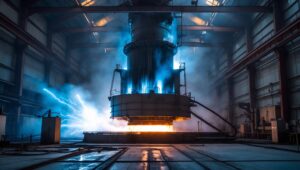
This is where the majority of cement’s environmental impact occurs. The manufacturing process involves several stages: raw material preparation (grinding and homogenisation of the raw meal), clinker burning in a rotary kiln at 1,400–1,500°C, clinker cooling, and final grinding of clinker with gypsum and any SCMs to produce the finished cement product.
The environmental impact of Module A3 is dominated by two emission sources. First, process emissions from the calcination of limestone — the chemical reaction CaCO₃ → CaO + CO₂ — which releases approximately 525 kg of CO₂ per tonne of clinker produced. This is a geochemical process that occurs regardless of the energy source used to heat the kiln. Second, fuel combustion emissions from the energy required to heat the kiln. Cement kilns traditionally use fossil fuels (coal, petroleum coke, natural gas), though many modern plants co-process alternative fuels including waste-derived fuels, biomass, and refuse-derived fuel.
CO₂ released per tonne of clinker from calcination alone — an unavoidable chemical reaction
Together, these two emission sources give Portland cement clinker a carbon intensity typically ranging from 800 to 1,000 kg CO₂e per tonne of clinker. The final carbon intensity of the cement product depends on the clinker-to-cement ratio — the proportion of clinker in the finished cement.
System Boundaries for Concrete (Modules A1–A3)
Concrete LCA follows the same modular structure but encompasses a different set of processes and inputs.
Module A1: Raw Material Supply
For concrete, Module A1 covers the supply of all constituent materials: cement (with its own upstream impacts), coarse and fine aggregates, water, and chemical admixtures (plasticisers, superplasticisers, air-entraining agents, retarders, accelerators). The cement component dominates the Module A1 impact — typically accounting for 70 to 90 percent of the total GWP of the concrete mix, depending on the cement content and type.
Module A2: Transport
Module A2 covers the transport of all raw materials to the concrete batching plant. Aggregates are heavy, low-value materials that are typically sourced from quarries within a few tens of kilometres of the batching plant. Cement may travel further, depending on the location of cement plants relative to concrete producers. Transport distances and modes (road, rail, water) vary significantly by region and directly affect the overall environmental profile.
Module A3: Manufacturing
Concrete manufacturing — batching and mixing — is relatively low-energy compared to cement production. The process involves weighing and measuring the constituent materials, mixing them in a batching plant, and loading the fresh concrete into transit mixers or other delivery vehicles. The electrical energy consumption of the batching plant is modest, and Module A3 for concrete typically contributes only a small fraction of the total cradle-to-gate GWP. The overwhelming majority of concrete’s environmental impact is inherited from its cement content in Module A1.
Key Impact Categories
While EN 15804+A2 requires reporting across a comprehensive set of environmental impact categories — including acidification, eutrophication, ozone depletion, photochemical ozone creation, abiotic resource depletion, and water use — the Global Warming Potential (GWP) dominates attention for cement and concrete for good reason.
The GWP of cement production is driven by the unavoidable process emissions from calcination (approximately 60 percent of total CO₂) and the combustion of kiln fuels (approximately 40 percent). No other industrial product has such a large proportion of its carbon emissions locked into a fundamental chemical reaction. This makes decarbonisation of cement uniquely challenging — and makes accurate GWP reporting through EPDs uniquely important for comparing different products and tracking progress over time.
| Emission Source | Share of Cement CO₂ | Reduction Lever |
|---|---|---|
| Calcination of limestone (CaCO₃ → CaO + CO₂) | ~60% | Lower clinker ratio, novel binder chemistries, carbon capture |
| Kiln fuel combustion | ~40% | Alternative fuels, energy efficiency, waste-derived fuels, biomass |
The Clinker-to-Cement Ratio: The Most Important Variable
The single most influential variable in cement’s environmental profile is the clinker-to-cement ratio — the mass fraction of clinker in the final cement product. Portland cement CEM I contains 95–100 percent clinker and has the highest carbon intensity. Blended cements (CEM II through CEM V under EN 197-1) incorporate supplementary cementitious materials that partially replace clinker, reducing the carbon intensity proportionally.
| Cement Type (EN 197-1) | Clinker Content | Typical GWP (kg CO₂e/t) |
|---|---|---|
| CEM I (Portland) | 95–100% | 700–900 |
| CEM II/A-L (Portland-limestone) | 80–94% | 600–750 |
| CEM II/B (Portland-composite) | 65–79% | 450–650 |
| CEM III/A (Blast furnace) | 35–64% | 350–500 |
| CEM III/B (Blast furnace, high GGBS) | 20–34% | 200–350 |
For example, a CEM III/B cement containing 66–80 percent GGBS may have a GWP of only 200–350 kg CO₂e per tonne, compared to 700–900 kg CO₂e per tonne for a CEM I. This three-to-fourfold reduction in carbon intensity makes the clinker ratio the most powerful lever available for reducing concrete’s environmental impact without requiring changes to the manufacturing process itself.
Supplementary Cementitious Materials (SCMs)
SCMs are materials that, when used in combination with Portland cement clinker, contribute to the properties of the hardened concrete through hydraulic or pozzolanic activity. The most commonly used SCMs in Europe are:
| SCM | Source | Typical Clinker Replacement | Availability Outlook |
|---|---|---|---|
| GGBS | By-product of iron production in blast furnaces | 50–80% | Stable but limited by steel production volumes |
| Fly ash | By-product of coal combustion in power plants | 15–35% | Declining in Europe as coal power is phased out |
| Limestone filler | Finely ground limestone | 6–35% | Widely available |
| Calcined clay (metakaolin) | Thermally activated natural clays | Variable | Gaining attention as globally abundant alternative |
Allocation challenge: The environmental allocation of SCMs is a contested methodological issue. Under economic allocation, by-products carry a small share of the parent industry’s burdens. Under the cut-off approach, they are treated as burden-free waste inputs. The choice of allocation method significantly affects the calculated GWP of blended cements, so it is important to check which method was used when comparing EPDs from different programme operators.
The environmental allocation of SCMs is a methodological challenge in LCA. GGBS and fly ash are by-products of other industries. Under economic allocation — one of several permitted approaches — they carry a small share of the environmental burdens of their parent processes (steel and coal power, respectively). Under the cut-off approach, they are treated as burden-free waste inputs. The choice of allocation method significantly affects the calculated GWP of blended cements and, by extension, concrete. EN 15804+A2 specifies the module D approach for end-of-life recycling benefits, but allocation of co-products at the input stage remains a PCR-level decision.
Carbonation: CO₂ Reabsorption by Concrete
One methodological topic of growing importance in concrete LCA is carbonation — the natural chemical process by which hardened concrete slowly reabsorbs atmospheric CO₂ over its service life. The calcium hydroxide (Ca(OH)₂) and calcium silicate hydrate (C-S-H) in hardite react with atmospheric carbon dioxide, forming calcium carbonate (CaCO₃). In essence, carbonation partially reverses the calcination reaction that released CO₂ during clinker production.
The rate of carbonation depends on several factors: concrete porosity, cement content, exposure conditions (humidity, CO₂ concentration), and surface-to-volume ratio. For structural concrete within a building envelope, carbonation proceeds slowly — typically penetrating only a few millimetres per year. However, after demolition, when concrete is crushed into small particles with a large surface area, carbonation accelerates significantly.
Methodological status: EN 16757, the product-category rules for concrete, provides a framework for accounting for carbonation in Module B1 (use stage) and in Module C (end of life, after crushing). However, carbonation accounting remains an area of active methodological discussion. Not all programme operators and PCRs have adopted the same approach, and the magnitude of the credited CO₂ uptake is sensitive to assumptions about exposure conditions, service life, and post-demolition processing. When evaluating concrete EPDs, check whether carbonation has been included and under which scenario assumptions.
For manufacturers of blended cements with lower clinker ratios, the carbonation benefit is proportionally smaller (less Ca(OH)₂ available to react), but the starting GWP from calcination is also lower. The overall effect on the comparative environmental profile depends on the specific mix design and the time horizon of the assessment.
Data Collection Challenges
Conducting an LCA for cement or concrete requires detailed data on energy consumption, raw material inputs, transport distances, emission factors, and waste generation. For cement plants, this data is often available because large cement manufacturers operate continuous emission monitoring systems and maintain detailed production records for regulatory compliance (including EU ETS reporting). The challenge is ensuring that the data represents the specific plant and product being declared, not a company average or an outdated dataset.
For concrete, data collection is more fragmented. Concrete is produced at thousands of small batching plants, many of which have limited environmental monitoring capabilities. The mix design — the specific recipe of cement, aggregates, water, and admixtures — varies from batch to batch depending on the application, structural requirements, and local material availability. An EPD for concrete must specify the declared mix design and ensure that the data reflects actual production at the declared plant.
From LCA to EPD: The Path to Publication
- Conduct the Life Cycle Assessment. Collect production data and model environmental impacts across modules A1–A3 according to EN 15804+A2 and the applicable Product Category Rules.
- Ensure PCR compliance. Verify that the LCA results are formatted and reported in accordance with the relevant Product Category Rules for cement or concrete.
- Submit for independent verification. Have the EPD and supporting LCA report reviewed by an independent third-party verifier.
- Publish through a programme operator. Register and publish the verified EPD through a recognised programme operator such as EPD Polska.
- Maintain and update. Keep the EPD current — review and update when production processes, mix designs, or data change significantly.
Once the LCA is complete, the results form the basis of an Environmental Product Declaration. The process of moving from LCA to published EPD involves several steps: ensuring compliance with the relevant Product Category Rules (PCR), formatting the results according to EN 15804+A2 requirements, submitting the EPD and supporting LCA report for independent third-party verification, and finally publishing through a recognised programme operator.
EPD Polska offers this publication pathway for Polish cement and concrete manufacturers, providing the verification and registration services needed to produce a credible, market-recognised declaration. For manufacturers seeking to understand how to obtain an EPD, the LCA described in this guide is the technical foundation upon which the entire declaration rests.
The resulting EPD for cement or concrete reports GWP and other impact indicators per declared unit — typically per tonne of cement or per cubic metre of concrete of a specified strength class. This standardised, verified format allows specifiers and designers to compare products on a like-for-like basis, supports cross-material comparisons for structural design optimisation, and feeds into building-level LCA for regulatory and certification purposes.
Implications for Polish Cement and Concrete Manufacturers
Strategic advantage: Poland is one of the largest cement producers in the EU, with a production capacity exceeding 20 million tonnes per year. As regulatory requirements under CBAM, CSRD, and the EU Taxonomy converge around verified environmental data, Polish manufacturers that invest in LCA and EPD capabilities position themselves at the forefront of market readiness.
Poland is one of the largest cement producers in the EU, with a production capacity exceeding 20 million tonnes per year. Polish concrete producers serve both the domestic market and increasingly export to neighbouring countries. As regulatory requirements under CBAM, CSRD, and the EU Taxonomy converge around verified environmental data, Polish manufacturers that invest in LCA and EPD capabilities position themselves at the forefront of market readiness. The implications of CBAM for cement make verified emission data particularly critical for cross-border trade.
Frequently Asked Questions
What is the typical GWP range for Portland cement and blended cements?
Portland cement CEM I typically has a GWP in the range of 700 to 900 kg CO₂e per tonne, depending on the specific plant’s energy efficiency, fuel mix, and clinker factor. Blended cements vary widely: a CEM II/A-L (Portland-limestone) might be 600–750 kg CO₂e per tonne, while a CEM III/B (blast furnace cement with high GGBS content) can be as low as 200–350 kg CO₂e per tonne. These figures illustrate why the clinker-to-cement ratio is the dominant factor in cement’s carbon intensity.
Why does concrete GWP vary so much between mix designs?
Concrete GWP is primarily determined by the type and quantity of cement used per cubic metre. A high-strength concrete (C50/60) may require 400 kg of CEM I per cubic metre, while a standard structural concrete (C25/30) might use 280 kg of CEM II/B with 30 percent fly ash. The difference in GWP between these two mixes can be a factor of three or more. Additionally, the use of recycled aggregates, alternative binders, and optimised mix designs can further reduce GWP.
How is the allocation of GGBS and fly ash handled in cement and concrete EPDs?
This is one of the most debated methodological questions in construction LCA. The approach depends on the Product Category Rules applicable to the EPD. Some PCRs adopt an economic allocation, assigning a small share of the parent industry’s environmental burden to the by-product. Others use a system expansion or substitution approach. EN 15804+A2 requires that net benefits from recycling be reported in Module D. The choice of approach can significantly affect the reported GWP of blended cements and concretes, so it is important to check which method was used when comparing EPDs from different programme operators.
Can concrete producers use generic data for aggregates and water in their EPDs?
While the use of specific, measured data is always preferred, EN 15804+A2 and most PCRs allow the use of generic data from recognised LCA databases for processes that contribute less than a defined threshold (typically 1–5 percent) to the total impact. For concrete, aggregates and water typically contribute a small fraction of total GWP, so generic data may be acceptable. However, cement — the dominant contributor — must always be based on specific data, ideally from the cement supplier’s own EPD or verified production data.
Does concrete carbonation affect EPD results?
It can. Carbonation — the reabsorption of atmospheric CO₂ by hardened concrete — partially offsets the CO₂ released during clinker calcination. EN 16757 provides a framework for including carbonation in Module B1 (use phase) and Module C (end of life). However, the magnitude of the effect depends on exposure conditions, service life, and post-demolition crushing scenarios. Not all EPDs include carbonation, and methodological approaches vary between programme operators. When comparing concrete EPDs, check whether carbonation has been accounted for and under which assumptions.
How long does it take to develop an EPD for cement or concrete?
The timeline varies depending on data readiness and organisational complexity. For a cement plant with good production records and existing environmental monitoring, the LCA data collection might take four to eight weeks, the LCA modelling and reporting another four to six weeks, and the third-party verification two to four weeks. The total process from initiation to published EPD is typically three to six months. For concrete, the process can be faster if the cement supplier already has an EPD, since the cement EPD data feeds directly into the concrete LCA. Working with an experienced programme operator such as EPD Polska can help streamline the process.